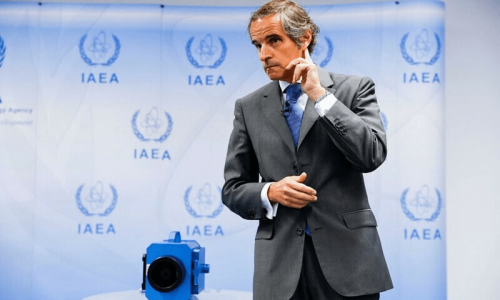
TEHRAN: International Atomic Energy Agency chief Rafael Grossi arrived in Iran on Wednesday for discussions on Tehran’s nuclear programme, a week after Donald Trump’s election as the new US president.
Grossi, who is the director general of the UN agency, was greeted on Wednesday evening at the airport by Behrouz Kamalvandi, the spokesman for the Atomic Energy Organisation of Iran or AEOI.
Grossi is set to meet on Thursday in Tehran with AEOI chief Mohammad Eslami as well as Foreign Minister Abbas Araghchi, who was chief negotiator in the nuclear talks between Tehran and the major powers that resulted in the 2015 deal formally called the Joint Comprehensive Plan of Action or JCPOA.
The deal, reached after 21 months of negotiations between Iran and world powers, gave Tehran sanctions relief in exchange for curbs on its nuclear programme to guarantee that it could not develop a nuclear weapon — something it has always denied wanting to do. Three years later, then-president Trump unilaterally withdrew the United States from the agreement and reimposed heavy sanctions against Iran.
European powers pushing for resolution against Iran at IAEA
‘Comprehensive report’
European powers are pushing for a new resolution against Iran by the UN atomic watchdog’s board to pressure Tehran over its poor cooperation, diplomats say.
Such resolutions risk further diplomatic tension with Iran. The resolution would task the IAEA with issuing a so-called “comprehensive report” on Iran’s nuclear activities in addition to its regular quarterly ones, which would describe in more detail and put further focus on problem areas like Iran’s continued failure to explain uranium traces found at undeclared sites.
The aim is to force Iran back to the negotiating table to agree new restrictions on its nuclear activities in exchange for sanctions relief.
“Our concerns about Iranian nuclear activity are well known. It feels a natural point to be asking the IAEA for a thorough report. That then provides a basis to deal with Iranian behaviour,” a European diplomat said, one of five who said France, Britain and Germany are pushing for a resolution.
The United States has not been the driving force behind the resolution but is still expected to back it, as happened with the last resolution against Iran in June, diplomats said. The European powers seeking a resolution, known as the “E3”, are discussing the draft with the outgoing US administration.
Published in Dawn, November 14th, 2024