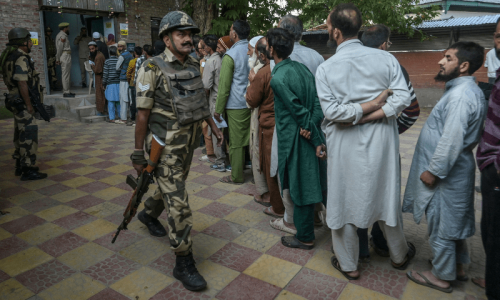
SRINAGAR: In a first, foreign diplomats from some 15 countries were allowed to observe voting in India-held Kashmir on Wednesday, the first electoral exercise in the disputed region since 2014.
The visitors included diplomats from embassies of the US, Mexico, Singapore, Spain and South Korea, among others, officials in Srinagar and New Delhi said.
Soldiers carrying rifles stood outside polling stations across India-held Kashmir as voters queued to participate in the second phase of elections, the first since New Delhi revoked its semi-autonomous status in 2019.
The change by Hindu-nationalist PM Narendra Modi brought the disputed region under the government’s direct control and was accompanied by mass arrests and a long communications blackout.
After 10 years without elections, locals say they are desperate for representation; ‘Black Day’ observed in AJK
Since then, the territory has been without an elected government, ruled instead by a federally appointed governor.
Key decisions still remain with New Delhi, however, and it also has the power to override legislation passed by the 90-seat assembly.
Polling in the first stage of the three-phased election was held on Sept 18, when around 61 per cent of voters are said to have cast ballots.
The last round of voting will be held on October 1 with results expected a week later.
“It is a rare opportunity to come to Kashmir and see the electoral process in action and see democracy. It looks very smooth, everything is very professional,” said Jorgan K. Andrews, deputy chief of mission at the US embassy.
But Modi’s opponents said the visit by diplomats was not necessary.
Questioning the Modi government’s motives, Omar Abdullah, leader of the local National Conference party pointed out the contradiction in its stance.
When foreign governments comment, the government of India says it’s an internal matter. But now they want foreign observers to come and monitor our elections, he said.
“Jammu and Kashmir elections are an internal matter for us and we do not need their certificate,” he said, after casting his vote, and accused the Modi government of humiliating and harassing the people, using its machinery to detain and suppress them.
Despite this, people are participating in the election, which Abdullah said was a testament to their resilience.
Keen for representation
A high unemployment rate and anger at the 2019 changes have animated campaigning and regional parties have promised to fight for restoration of autonomy.
“We want to have a representative who will take our grievances forward,” said Abdul Rahim, 52, after casting his vote.
“Our children are locked up and we are suffering. They (the government) abrogated Article 370 (which granted Kashmir its special status) so we don’t have any representatives who can question their moves.”
“Since the last election ten years ago we were left at the mercy of God,” said Tariq Ahmed, 40 after casting his vote.
“I am happy this election is happening. I hope we get our own representative with whom poor people like myself can raise everyday issues.”
‘Black Day’
Meanwhile, demonstrations were held across the Line of Control (LoC) in Azad Jammu and Kashmir (AJK) as a ‘Black Day’ was observed over the polls in India-held Kashmir.
The protests in Muzaffarabad, organised by Pasban-i-Hurriyat Jammu and Kashmir, were attended by a large number of citizens and leaders from various political and religious parties.
The protesters marched towards the UN observer office, demanding international intervention to resolve the Kashmir dispute.
In Mirpur and Rawalakot, protest rallies and processions were held with participants raising anti-India and pro-freedom slogans.
Addressing the rallies, the speakers declared that any sort of elections in the internally acknowledged disputed occupied Jammu & Kashmir state under the Indian constitution had no legal validity nor could be the substitute of the Kashmiris legitimate right of self-determination committed by the international community through UN resolutions on Kashmir issue.
They declared that the people of Jammu & Kashmir neither ever accepted the illegal occupation of their motherland by India in the past nor would accept it at any cost in the future.
Published in Dawn, September 26th, 2024