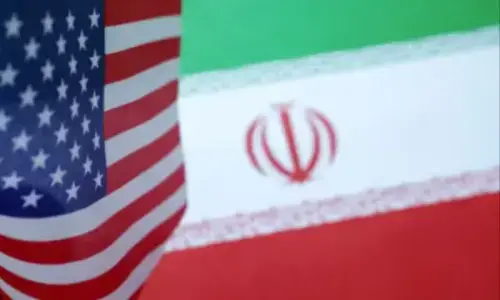
THE US and Iran are currently somewhere between war and peace. While a tenuous ceasefire — extended largely due to Pakistan’s efforts — still holds, negotiations are deadlocked, and both states have said they are ready to resume hostilities. Meanwhile, the respective Iranian and US blockades of the Strait of Hormuz also continue, causing the global economy much pain, with consumers across Europe and Asia, and beyond, facing a fresh wave of inflation.
On Friday, media reports said that the Iranians had sent a new set of proposals to the US via Pakistan. As per reports, US President Donald Trump has said he is not satisfied with the proposal. He had similarly rejected the last offer from Tehran, which had called for opening up Hormuz, while leaving nuclear talks for another day. The Pakistan Foreign Office had earlier said that the “clock on diplomacy has not stopped”.
Regrettably, the latest developments show that the window for diplomacy will not remain open for an indefinite period. Washington is apparently planning “short and powerful” strikes against Tehran; the Iranians have said they will retaliate with “long and painful strikes”. On the other hand, Israel has also said it is prepared for fresh action against the Islamic Republic. All this bodes ill for the peace process, and unless there is a significant diplomatic breakthrough, a return to hostilities cannot be ruled out.
The US had made a hypothetical Iranian nuclear bomb — a largely manufactured threat — a point of contention. In multiple reviews the American intelligence community has said that Iran is not racing to make the bomb. The Trump administration has conveniently overlooked these facts. Moreover, Iran has offered on a number of occasions to freeze — though not end — uranium enrichment. Therefore, it appears that while Iran is willing to make compromises on the nuclear issue, the US is not. For peace to become a reality, this rigid attitude must change.
If the US wants a peace deal with Iran, there may still be time to reach an agreement that is acceptable to both sides. But if it is seeking total capitulation by Tehran, with Iran renouncing the right to defend itself, and forever give up enrichment, its objective — which is shared by Israel — will be near impossible to achieve.
Should Iran be willing to reopen the Strait of Hormuz, the US must consider the offer, and come back to the nuclear issue after tensions between the two cool off. But if pro-war hawks in Washington, and their friends in Tel Aviv, have their way, peace efforts may soon be dashed, with a return to conflict. Mr Trump has said he wants to ‘save’ Iran. The Iranians can save themselves; the US should, instead, exit this conflict immediately.
Published in Dawn, May 2nd, 2026