• UN team meets interior minister, slams terror attacks
• Pakistan seeks international help in refugees’ return
• Naqvi says TTP conducts attacks from Afghan soil
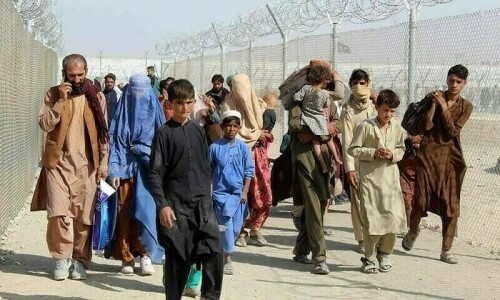
ISLAMABAD: Pakistan on Wednesday declared that no one can be allowed to stay in the country without legal documents and that the second phase of the repatriation of Afghan refugees will be launched soon.
Interior Minister Mohsin Naqvi announced this during a meeting with a UN delegation led by Special Representative for Afghanistan Indrika Ratwatte.
Pakistan launched the deportation drive last year after a spike in suicide attacks that the government believes were carried out by Afghan nationals. Islamabad also blamed them for smuggling, militant violence and other crimes.
Mr Naqvi, who welcomed the UN delegation at the Ministry of Interior, emphasised the need for the role of UN and the international community in the rehabilitation of Afghan refugees.
The minister said terrorism was a global issue and Pakistan was the most affected country. He highlighted that Pakistan’s security forces, police, and people had rendered unparalleled sacrifices in the war against terrorism.
He informed the UN delegation about the involvement of the banned TTP in the terrorist attacks in Pakistan. The delegation included UN Resident Coordinator Mohamed Yahya, Fady El Meouchy, Special Assistant to the DSRSG and Head of the UN mission in Afghanistan Malick Ceesay.
Mr Naqvi stated that the banned TTP is using Afghan soil for these attacks, which must be stopped.
He said Pakistan was desirous of peace and stability in Afghanistan and is providing all possible support in this regard.
He said Pakistan has been hosting Afghan refugees for decades, adding that the phase-wise repatriation of illegal foreigners has already been started.
The minister assured the delegation that no action was being taken against individuals holding legal documents.
Ratwatte praised Pakistan’s role about Afghan refugees and Doha dialogue. He said UN is closely working with the Afghan government for the permanent rehabilitation of Afghan refugees.
The UN special representative condemned recent terrorist attacks in Balochistan.
An official said that Afghan nationals, who had been issued Afghan Citizen Cards (ACCs), will be repatriated during the second phase of the drive to expel aliens.
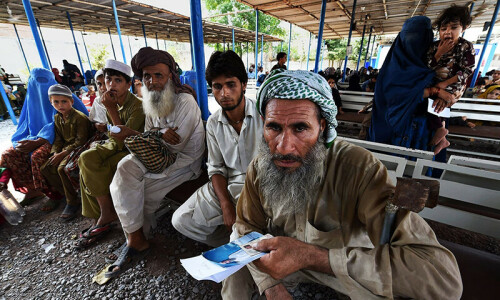
According to the UNHCR, the UN refugee agency, there are 2.18 million documented Afghan refugees living in Pakistan.
This includes the 1.3m refugees holding Proof of Registration (PoR) cards as per the census carried in 2006-07, as well as an additional 880,000 refugees who were granted ACCs following a registration drive in 2017.
The return of Taliban to power in August 2021 saw another influx of worried Afghans into Pakistan. Officials put their number anywhere between 600,000 and 800,000, some with valid travel documents, but an uncertain future.
Pakistan launched the first round of repatriation of what it called “undocumented aliens” in November last year.
Awaiting relocation
Disclosing that at least 44,000 Afghans approved for relocation to western nations following the Taliban’s return to power were still waiting in limbo in Pakistan, the Foreign Office had last month asked these countries to expedite the process.
Those awaiting relocation include 25,000 Afghans approved for relocation to the US. A further 9,000 Afghans resident in Pakistan have been accepted by Australia, as have 6,000 by Canada, 3,000 by Germany, and more than 1,000 by Britain.
“We have urged them to expedite the approval and visa issuance process for these countries for these individuals, so that they are relocated as early as possible,” the FO spokesperson had told reporters.
Prime Minister Shehbaz Sharif had also last month raised with the UN High Commissioner for Refugees Filippo Grandi the matter of backlog of Afghans awaiting relocation, as well as the large numbers of refugees who have arrived with no plans for onward travel.
Afghans make up the largest portion of migrants, many of whom came after the Taliban took over Kabul in 2021, but a large number have been present since the 1979 Soviet invasion of Afghanistan.
In October 2023, Pakistan announced phase one of the “Illegal Foreigners’ Repatriation Plan” with a 30-day deadline for “undocumented” aliens to leave the country or be ready to face action.
Around half a million Afghans are believed have been expelled under this phase.
In phase two, Afghans holding ACCs will be expelled while phase three is expected to target those with UNHCR-issued Proof of Registration (PoR) cards.
Published in Dawn, August 29th, 2024