THE first round of ‘engagement’ between Pakistan and the IMF over the former’s request for a larger and longer programme appears to have concluded — with some bumps still visible. Both sides are believed to have reached an understanding on the reform measures that Islamabad must include in the budget for the next financial year and get approved by parliament before an agreement on a new bailout facility is signed.
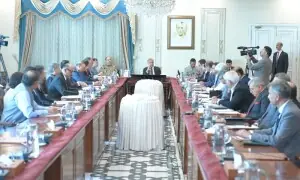
A report in this paper has quoted a government official as saying that the IMF mission is leaving the country without announcing a formal staff-level agreement, because the “Fund wants a stamp of approval from parliament for the reforms and policy actions [to be implemented as ‘prior actions’ for the new programme] given the unpredictable political environment”.
This is not a new condition in Pakistan’s context, nor is it surprising, considering the endless political instability roiling the country. The IMF had recently noted that high political uncertainty and the resurgence of social tensions could undermine economic stabilisation.
“Downside risks remain exceptionally high. While the new government has indicated its intention to continue the [Stand-by Arrangement’s] policies, political uncertainty remains significant,” the IMF had said in its staff report on the conclusion of the second and final review of the $3bn SBA. It added that “the resurgence in social tensions reflecting the complex political scene and high cost of living could weigh on policy and reform implementation”.
Despite its concerns that the political situation might create obstacles in the way of parliamentary approval of the new budget, the IMF has also expressed its confidence in the present political administration.
“The return of the outgoing government to power after the elections means continued commitment to the reform agenda agreed at the time of the SBA. This not only means a higher likelihood for the continuity of reforms but also political stability for the next five years. The current coalition government consists of almost the same political parties, which despite heavy political cost implemented all the actions committed under the [Extended Fund Facility] programme and approved all the prior actions under the SBA,” it said.
It is thus anticipated that the Fund will conclude a new loan latest by early July. However, a new arrangement is the least of the common man’s problems. The real issue for most is the additional financial burden in the shape of new levies — such as a hike in the petroleum levy, an increase in indirect taxes, more taxes on salaries — and enhanced energy prices that they will have to bear as the cost of the new loan. Going by the just-concluded engagement with the IMF mission, it is clear that the next phase of economic stabilisation will be very tough for most of the population.
Published in Dawn, May 24th, 2024