Two pythons released in wild in AJK
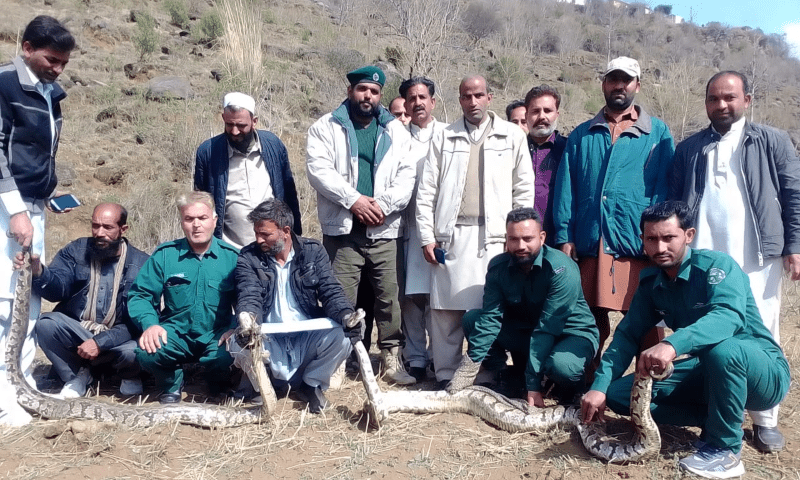
MUZAFFARABAD: Two Indian rock pythons were released by the wildlife officials into their natural habitatin Kotli district of Azad Jammu and Kashmir (AJK)on Sunday hours after they were spotted close to a human settlement.
Hameed Gorsi, a field supervisor in Kotli district, told Dawn by telephone that they had received a report from Gulpur area in Charhoi tehsil that two Indian pythons had been spotted near human population.
“Since our staff was already present at the nearby Mahseer Fish Hatchery in connection with observance of the World Wildlife Day, we immediately dispatched them to the reported area, where a large number of people from the local community had also reached,” he said.
Mr Gorsi said that the wildlife staff safely rescued both non-venomous snakes, measuring 8 to 9 feet each, and released them in a secure habitat, away from the human population.
While expressing gratitude to the local community for timely alerting the wildlife department about the presence of the pythons, the wildlife officials also seized the opportunity to enhance awareness among them regarding the importance and usefulness of wildlife, he said.
The Indian python (python molurus) is a large python species native to tropical and subtropical regions of the Indian subcontinent and Southeast Asia. It is also known by the common names black-tailed python, Indian rock python and Asian rock python.
In Azad Kashmir, they are found in Bhimber, Mirpur and Kotli districts of Mirpur division.
Mirpur-based wildlife assistant director Mohammad Sajid said previously a large number of people would kill pythons, wrongly assuming that they engulfed their sheep and goats while these non-venomous snakes feed themselves on rodents, jackals, small monkeys and wild boars and some other wildlife species.
This was why the population of pythons was at risk of extinction in AJK, he said, adding that lately their population had recorded a considerable increase in Mirpur division because of the greater awareness among the people about conservation of wildlife.
Over the past two years, over a dozen pythons were rescued from different areas of Mirpur division and subsequently released into their natural habitat, Mr Sajid said.
Published in Dawn, March 4th, 2024