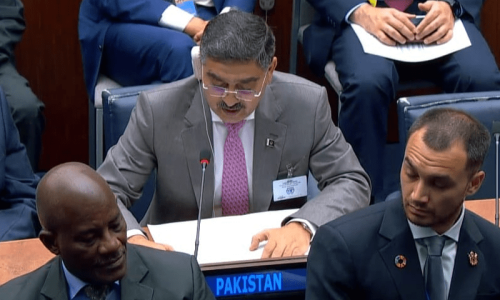
COP28 deliberates financing, carbon credits



DUBAI: Money pledges stacked up at COP28 in Dubai on Monday as delegates sought to address the huge gap between what is needed in climate finance and the amounts so far on offer.
The United Arab Emirates, the host of this year’s conference, pledged to mobilise $270 billion in green finance by 2030 through its banks, and several development banks announced plans to increase their funding efforts, including by agreeing to pause debt repayments if a climate-related disaster hits.
But leaders of the region’s biggest economy and biggest OPEC oil producer Saudi Arabia have so far not attended the U.N. summit, in contrast to their participation in last year’s COP27 conference in Sharm el-Sheikh, Egypt.
However, in a video message to the Saudi Green Initiative forum, held on the sidelines of COP28, Prince Abdulaziz bin Salman dismissed Western donations to a new climate loss and damage fund as “small change”, while trumpeting Riyadh’s pledges of cash to developing countries.
Loss and damage
Vulnerable countries that are already being hit by costly climate disasters are asking for billions more through a newly-formed disaster fund. Pledges to the fund so far total around $700 million.
Riyadh derides Western pledges as ‘small change’; vulnerable countries suggest new taxes to finance disaster fund
“Unless we have an urgent set of decision-making, we are going to suffer what every parent suffers from — exciting expectations and being unable to deliver,” said Barbados Prime Minister Mia Mottley, a prominent voice in global discussions about mobilising climate finance.
A global 0.1pc tax on financial services, for example, could raise $420 billion, she said, while a 5pc tax on global oil and gas profits in 2022 would have yielded around $200 billion.
Carbon credits
The climate talks in Dubai have also been flooded with announcements hyping controversial carbon credits before rules for them have been hammered out, with environmental groups fearing “greenwashing” on a massive scale.
The concept behind the credits has taken a major hit recently as scientific research has repeatedly shown claims of reduced emissions under the schemes are often hugely overestimated — or simply non-existent.
Carbon credits allow corporations — or countries under certain conditions — to offset their greenhouse gas emissions.
One credit equals the reduction or removal of one tonne of CO2 from the atmosphere, often in developing countries by projects focusing on things like fighting deforestation.
Scientists stress that any offsetting should not be used as a passport to continue polluting, with emissions needing to fall by almost half this decade to meet global warming goals.
US climate envoy John Kerry declared on Sunday that his country’s Energy Transition Accelerator for developing nations — one of a number being touted — as a “bold new idea” .
However environmental groups quickly expressed scepticism, pointing to the past failures of similar schemes.
Amazon, Bank of America, Mastercard, McDonald’s, Morgan Stanley, PepsiCo and Walmart are some of the US corporate giants lining up to pilot projects in Chile, the Dominican Republic and Nigeria.
Published in Dawn, December 5th, 2023