CHILDREN are a country’s most precious investment. But in Pakistan, poor children don’t fall in this category. Even after 75 years of existence, we as a nation have not given sufficient importance to child rights.
Child domestic labour refers to hiring children under 18 years in households, with or without a salary. Figures from 2016 showed 12 million child labourers in the country. A study in 2003 showed that eight per cent of all child labour was related to domestic work.
It is also estimated that around 40pc of Pakistanis live in poverty, with some 24pc below the poverty line. For families in such situations, survival is the primary goal. Due to lack of family planning, every child born becomes an additional burden on the parents. Instead of sending them to school, they are sent to work. In some households, having more children means more income, leading to a reprehensible scenario where children are birthed solely for financial gain. The conditions under which these children work is often irrelevant, as long as the parents receive a monthly salary.
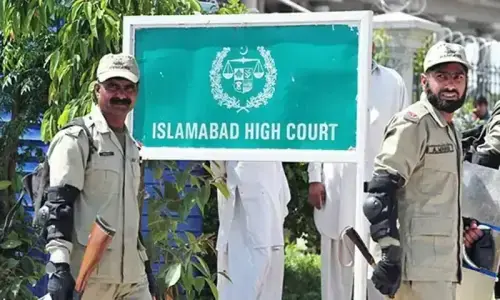
The situation is even more disheartening when child rights violations occur in the homes of educated and financially stable families. The recent case of 14-year-old Rizwana, who worked as domestic help in the home of a well-to-do judge is an example. Rizwana’s parents did not see her for six months. When they were finally called to take her home, they discovered she had been brutally abused. The responsibility for this situation lies with the judge and his wife, Rizwana’s parents, the trafficker who brought her from her village, and all those who silently watched her work without questioning the circumstances. It seems that our state is blind to these issues.
Hiring children isn’t a favour to them. It’s a crime.
Children are often preferred over adult domestic workers because they can be paid lower salaries, take up less space, require less food, and are easily controlled and threatened. It is ironic that employers often justify hiring children by claiming that they are helping them live their lives. Employing a child for work is not a favour; it is a crime. It robs them of their precious childhood. It denies them their right to education, trapping not only them but also future generations in a cycle of exploitation.
The proportion of girls involved in domestic labour is much higher than boys, perpetuating gender inequality and limiting future opportunities for girls. For these children, the stress from excessive workloads leads to anxiety, and the loneliness of being away from home can result in depression. Constantly comparing their lives to those of their employer’s children can cause low self-esteem and a sense of hopelessness. It can lead to feelings of jealousy, aggression, and cause conduct disorders. In some households, making these children work beyond their capabilities is not the end of it, as they are subjected to abuse — physical, sexual and psychological.
Another recent case is that of nine-year-old Fatima, who was sexually abused in the haveli of a pir or spiritual leader. Sadly, she succumbed to her injuries. It was later revealed that many other girls were living in the house as domestic workers. These girls are given as gifts to these pirs and feudal lords, and parents receive nominal amounts of money in return. Heartbreaking stories of child domestic labourers treated as slaves by their monstrous employers and often losing their lives come to light every now and then.
Pakistan has ratified conventions on child labour and has laws in place to address this issue. Punjab was the first province to pass a law specifically targeting domestic labour in 2019, which banned children below 15 years old from working as domestic labourers. Sindh does not have a specific law for child domestic labour, but when the Sindh Child Protection law was amended in 2021, child labour in domestic and commercial settings was included in the definition of child abuse, making it more than just a labour issue.
In 2020, a domestic labour law was passed in Islamabad Capital Territory as well. Despite having various laws on child rights, there is inconsistency in the definition of the upper age limit for a child in each law. To address this confusion, it is crucial to establish a unified definition of a child as anyone below 18 years old. This will help clarify the age criteria across all laws. Furthermore, child domestic labour should be banned and criminalised, with the offence being added to the Pakistan Penal Code as a non-bailable and non-compoundable offence.
We cannot afford to lose more children like Zohra, Tayyaba, Kinza, Rizwana and Fatima. Our society, lawmakers and government must prioritise action on poverty alleviation, population control, free compulsory education and protecting children from exploitation and abuse.
The writer is a paediatrician at AKUH.
X (formerly Twitter): @kishwarenam
Published in Dawn, September 13th, 2023