SIFC unveils new visa policy to woo Gulf, global investors



ISLAMABAD: The Special Investment Facilitation Council (SIFC) unveiled a new visa policy on Saturday, targeting increased investments from the Gulf Cooperation Council (GCC) nations and other countries. The decision follows two days of thorough discussions by the council, which counts the army chief among its members.
The SIFC was established earlier this year to attract foreign investments from the Gulf nations and other friendly countries. However, Federal Law Minister Ahmad Irfan Aslam told Dawn after a presser on Saturday that, in contrast to the China-Pakistan Economic Corridor (CPEC) that has garnered significant funds from China, Western countries haven’t made definitive commitments to the SIFC yet.
However, he insisted that the SIFC and CPEC had different scopes and sectors for Chinese investment. While CPEC focuses on roads, infrastructure and energy projects, the SIFC allows China to invest in minerals and other areas that are not part of the corridor project.
Mr Aslam said that agreements had reached an advanced level with GCC countries, including Saudi Arabia, the United Arab Emirates and Qatar. “We will first sign the agreement with Saudi Arabia,” Mr Aslam said, adding that the signing of the agreement was expected by the year’s end.
To a question, the law minister admitted that he was only aware of Indonesia’s interest in investing under the SIFC, while Western and other non-GCC countries have not made any firm pledges yet.
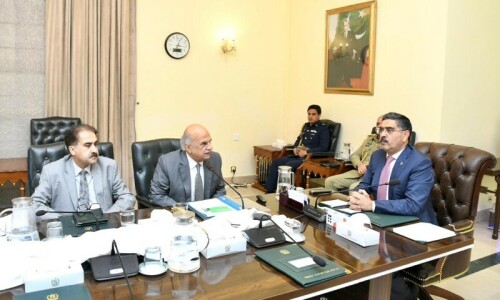
In a video message released after chairing the SIFC’s apex committee meeting, Caretaker Prime Minister Anwaarul Haq Kakar said that important decisions regarding the new visa regime had been taken.
He said Pakistani embassies would grant visas to business people who have a letter from either the host countries or any global business organisation. Moreover, invitations from Pakistani chambers and entrepreneurs to foreign business people would also suffice for visa issuance.
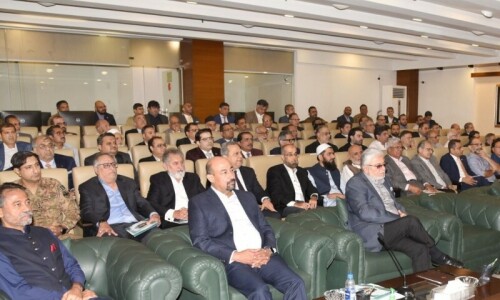
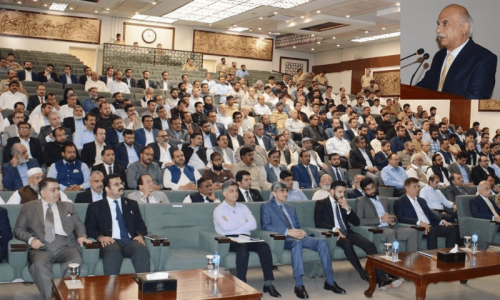
The prime minister’s secretariat said in a statement that the SIFC’s second session was arranged to seek input from the ministries of foreign affairs, interior, information technology, national food security and water resources to improve business and investment climate in the country.
Ministries presented comprehensive plans covering milestones, timelines and solutions to overcome major challenges.
‘Pro-active diplomacy’
Addressing a press conference, Caretaker Foreign Minister Jalil Abbas Jilani said that Pakistan was pursuing a pro-active diplomacy and its relations with other countries are improving. He said the SIFC was briefed on Pakistan’s relations with China, the United States and other Middle East countries.
He said GCC countries had shown interest in the investment council. Besides, Pakistan’s relations with African countries would improve following the full implementation of the ‘Look Africa’ policy, he said, adding that steps were being taken to solve international investors’ issues.
Zero tolerance for smuggling
Caretaker Interior Minister Sarfraz Ahmed Bugti also said that visas to international investors would be issued on easy terms. He said visas would also be offered to the staff of investors.
Mr Bugti said measures had been taken to prevent smuggling and there would be a crackdown on the smuggling of sugar, dollars, oil, fertiliser, wheat, etc. “There will be zero tolerance for smuggling and extortions,” he said.
He said the caretaker government had also resolved to expand the number of Pakistanis registered with Nadra from 78pc to 95pc, for which Nadra would soon reveal a strategy.
600,000 freelancers, $10 a day
Special Assistant on Overseas Pakistanis Jawad Sohrab Malik said that a special cell would be set up in the interior ministry to deal with the illegal land grabbing of overseas Pakistanis’ properties. He added that this issue would also be addressed at the provincial level and travel incentives would be offered to them.
IT Minister Dr Umar Saif announced that a nationwide programme would be launched to help 600,000 freelancers earn $5 to $10 per day. He estimated that this programme would generate around $3 billion annually. He also said that IT companies would be assisted to repatriate their export earnings.
He projected that overseas banks were holding $1 billion of Pakistani freelancers’ money because of repatriation problems. He also claimed that this figure was likely to increase.
Law Minister Aslam said that the caretaker government has a mandate under the Constitution to make decisions for the betterment of the people. “We need to make the decision to keep the IMF agreement intact,” he said.
To a question, he said President Arif Alvi would remain in office until the appointment of his successor. He also assured that the policies adopted by the interim government would be maintained.
Published in Dawn, September 10th, 2023