Indian rover confirms sulphur on Moon’s south pole


India’s Moon rover has confirmed the presence of sulphur on the lunar south pole, the country’s space agency said.
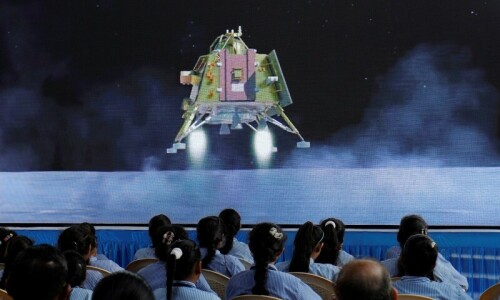
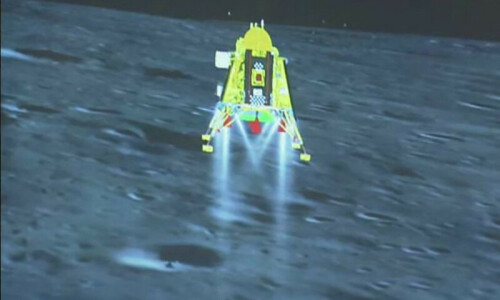
Last week, India became the first country to land a craft near the largely unexplored south pole, and just the fourth nation to land on the Moon.
“The Laser-Induced Breakdown Spectroscopy (LIBS) instrument onboard Chandrayaan-3 Rover has made the first-ever in-situ measurements on the elemental composition of the lunar surface near the south pole,” the Indian Space Research Organisation (ISRO) said in a statement dated Monday.
“These in-situ measurements confirm the presence of sulphur in the region unambiguously, something that was not feasible by the instruments onboard the orbiters,” it said.
The spectrographic analysis also confirmed the presence of aluminium, calcium, iron, chromium and titanium on the lunar surface, ISRO added, with additional measurements showing the presence of manganese, silicon and oxygen.
The six-wheeled solar-powered rover Pragyan — “Wisdom” in Sanskrit — will amble around the relatively unmapped south pole and transmit images and scientific data over its two-week lifespan.
India has been steadily matching the achievements of other space programmes at a fraction of their cost, despite suffering some setbacks.
Four years ago, the previous Indian lunar mission failed during its final descent, in what was seen at the time as a huge setback for the programme.
Chandrayaan-3 has captivated public attention since launching nearly six weeks ago in front of thousands of cheering spectators, and its successful touchdown on the Moon last week came just days after a Russian lander crashed in the same region.
In 2014, India became the first Asian nation to put a craft into orbit around Mars and plans to send a probe towards the sun in September.
ISRO is slated to launch a three-day crewed mission into Earth’s orbit by next year.
It also plans a joint mission with Japan to send another probe to the Moon by 2025 and an orbital mission to Venus within the next two years.