BATTAGRAM/GILGIT: In a tense operation, authorities announced on Tuesday that they had successfully saved eight individuals, including multiple schoolchildren, from a precarious situation in KP’s Battagram district.
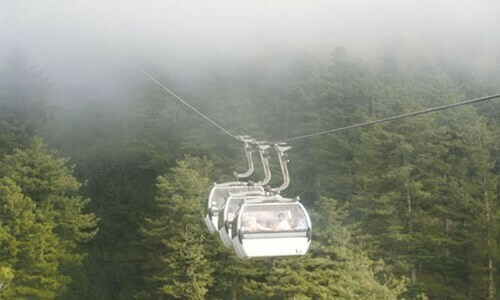
The stranded cable car, whose rope broke mid-air in Allai Tehsil, is suspended hundreds of feet over a mountainous valley.
Chairlifts, locally known as “Gardi” in GB, are traditionally used by people to cross rivers and shorten the distance needed to travel between valleys in the mountains.
Distances in mountainous areas like Battagram are far more than the crow flies and students have to spend two to three hours descending a steep mountainside, crossing a river, and then climbing another mountain. To cope with the situation, local engineers often install cable cars to assist students and locals in crossing the valley.
This drastically changes village life, as the once lengthy journey across the valley now takes a mere 10 minutes, albeit making it a precarious ask.
Design and construction
Local communities construct the cable cars using discarded materials such as the tops of pick-up trucks and Suzuki vehicles. These makeshift cabins are affixed to cables, occasionally made from scrap iron, and secured with ropes.
This construction approach is often unauthorised due to the lack of feasible options and the cost benefits when contrasted with constructing conventional infrastructure. In modern cable chairlifts, which are managed by operators, passengers can be easily transported from one side to another.
Safdar Hussain Safdar, a local resident of Ghizer, told Dawn that before the existence of roads and bridges, people typically used the Gardi to cross rivers and access areas. People in remote areas, particularly in Diamer, Skardu, Ghanche, Shigar, and Ghizer, still rely on chairlifts to cross rivers.
Despite providing a much-needed remedy, there are worries about the safety of these locally made cable cars. Earlier, in 2017, a cable car accident in Murree had led to the demise of 11 travellers.
Humayun Baber in Battagram, Jamil Nagri in Gilgit and Aleezeh Fatimah in Karachi contributed to this report
Published in Dawn, August 23th, 2023