0
0

RESEARCHERS and town planners need to examine how many times projects to make Karachi cleaner have been envisaged. It has been happening on a frequent basis, to little or no advantage to the city, for as long as one remembers. On July 17, 1973, for example, the many problems of Karachi and ‘ways and means of making it a beautiful place to live in’ — as desired by President of Pakistan Z A Bhutto — was discussed at a symposium on beautification of Karachi organised by the Pakistan National Centre.
Sindh local bodies secretary Rashid Ahmed, presiding over the discussion, disclosed that in the future the city would be managed by six municipalities and a large metropolitan corporation. There would be elections for those bodies and the elected metropolitan council would guide and regulate city affairs. Karachi Municipal Corporation (KMC) Administrator Mazhar Rafi in his speech told the attendees that Rs3.9crore was earmarked in the budget for development in the Sindh capital.
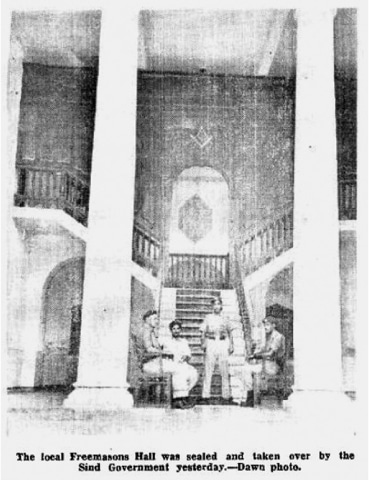
If on the one hand progress was being considered for a better future, on the other hand, on July 18, the past came into the limelight when the local Freemason Hall was sealed and taken over by the Sindh government, along with [its related] documents, under the supervision of the area magistrate. A police posse was also posted at the hall.
In a story published in this newspaper it was said that the first lodge in Karachi — Lodge Hope — was established under the Scottish Constitution on Sept 7, 1843 with a warrant granted by Lord Ramsay, Marquess of Dalhousie, Governor-General of India. Sir Charles Napier, the first governor of Sindh, became its honorary member after which its foundation was laid. Freemasonry came to the subcontinent when Freemason lodges were established in Calcutta (now Kolkata) in 1730, Madras (now Chennai) in 1732 and Bombay (now Mumbai) in 1758. The lodges were ‘active’ throughout Pakistan particularly in Karachi (headquarters), Hyderabad, Sukkur, Lahore, Multan, Rawalpindi, Tarbela, Quetta and Peshawar. There were 1,750 members in Pakistan. The (then) present building on Strachan Road in Karachi adjacent to the Pakistan Institute of International Affairs (PIIA) office was rebuilt in 1917.
That may or may not be an issue that the public was interested in. What it was concerned with was nutrition. On July 19, it was reported that Karachiites had gone without butter for two days. As soon as vanaspati ghee vanished from the market — which was mentioned in this column a couple of weeks back — following the government’s stern warning against wholesalers and retailers, people had switched over to butter as its alternative. Now all stocks of butter seemed to have been exhausted. Many city bakeries were not selling it either.
The one thing that Karachi seldom faced shortage of, and no different is the case today, is artistic activity. On July 21, the National Theatre Group presented Samuel Beckett’s play Endgame at the Pak-American Cultural Centre (PACC). It was Shad Moarif’s first directorial attempt. Like all of Beckett’s dramas, Endgame depicts the human condition rather than situations, revealing the mind of a person discontented with his social life. Hamm, the main character, suffers from paralysis and Clov, a waif whom he adopts, has arthritis. Both symbolise the decay of mankind. Their weaknesses are complementary to each other — this means, while Hamm cannot stand, Clov cannot sit.
Published in Dawn, July 17th, 2023