Suo motu powers lie with SC, not just CJP: Justice Qazi Faez Isa


Justice Qazi Faez Isa, senior puisne judge of the Supreme Court (SC), said on Wednesday that the Constitution gave the top court as a whole the right to take suo motu notice, adding that this power did not exclusively lie with the chief justice of Pakistan (CJP).
He made the remarks while speaking during an event celebrating the Constitution’s golden jubilee. During the event, Justice Isa — who is slated to become the next CJP in September — was asked about the difference in opinion regarding the top judge’s suo motu powers.
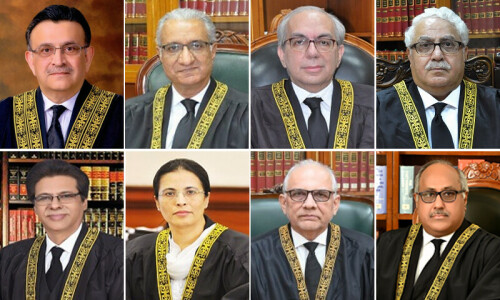
It should be noted that on March 29 Justice Isa and Justice Aminuddin Khan had ruled that the CJP did not have the power to make special benches or decide its members and that all hearings based on suo motu notices and cases of constitutional significance should be postponed until they were legislated upon. However, the order was eventually recalled by a six-member larger bench earlier this month.
“The meaning of the SC in Article 184(3) is that all judges and the chief justice unanimously [take suo motu notice],” Justice Isa said.
“My opinion is that […] when the court sits, you call it the SC and Article 184(3) starts with ‘Supreme Court’. It does not mention senior puisne judge or chief justice. So my opinion is that only the SC has this right.”
Article 184(3) of the Constitution sets out the SC’s original jurisdiction, and enables it to assume jurisdiction in matters involving a question of “public importance” with reference to the “enforcement of any of the fundamental rights” of Pakistan’s citizens.
Justice Isa’s remarks come amid a growing debate in recent weeks about the CJP’s suo motu powers. A bill aimed at depriving the office of the CJP of powers to take suo motu notice in an individual capacity has also been passed by the Parliament.
However, the implementation of the bill, which is yet to become law, has been curbed by a larger bench headed by CJP Umar Ata Bandial.
During today’s event, Justice Isa said that some of his colleagues were of the opinion that only the CJP could exercise the right to take suo motu notice. “The Constitution does not say this. If it does, you may tell me the article.”
Talking about another “opinion” regarding the CJP being the “master of the roster”, he again stated that there was no mention of it in the Constitution. The senior judge said that the word suo motu was a Latin term that was not even mentioned in the Constitution.
He said there were “certain requirements” — such as if the matter was of public importance or if enforcement of fundamental rights was required — for which a suo motu notice could be taken under Article 184(3).
He said that as per his understanding, Article 184(3) was meant for those treated unjustly, such as “brick kiln workers, bonded labourers, women who were being deprived of education, forced child labour” as such citizens did not have access to legal representation.
He termed the article to be meant for the protection of such people, noting that it had been used “abundantly” in Pakistan.
Expanding upon the circumstances when Article 184(3) should be invoked, Justice Isa said it could not be used to benefit a specific person and should instead be used in matters which affected society as a whole and which concerned fundamental rights.
“Where these two things are not applicable simultaneously, this article cannot be used,” he added.
The senior apex judge also said that this was the only kind of case where there was no right to appeal the court verdict. “When this article is brought into use, one should be very vigilant in each step they take.”
‘Differences and ego have no relation’
On the matter of him having differing views from some of the apex court justices, Justice Isa termed “ego” to be something a judge should not possess and said that having differences did not mean having a huge ego.
“When you are in [an important] role, you should not have any ego. If you are a professor, it is possible that your student might know more than you. If you possess an ego, you would frown upon him. This is wrong,” Justice Isa said.
“The day my ego would reflect [in matters], I would not remain a judge. So there are differences — only differences. […] Differences and ego have no relation,” he added.
‘Article 58(2b) another seed of hatred’
Recalling events from Pakistan’s political history comprising of dictatorships and constitutional amendments, Justice Isa also brought up Article 58(2b).
“For his protection, he (General Ziaul Haq) inserted another constitutional article that came to be known as Article 58(2b), so that when he wishes, he can dismiss an elected government,” he said.
Terming Article 58(2b) to be “another seed of hatred and bitterness”, the senior judge said that “Gen Zia made use of the power himself and then the next president, Ghulam Ishaq Khan, also used Article 58(2b)”.
“In fact, used it twice — once to dismiss Benazir Bhutto’s government and the second time to dismiss Nawaz Sharif’s government,” he added.
Justice Isa remarked, “It also brings some shame to me that the Supreme Court kept on supporting these steps. It was challenged that the resolution is wrong but they (the SC) said ‘Let’s move on’.”
The senior apex judge also criticised late military dictator Gen Parvez Musharraf, saying, “On Oct 12, 1999, another government official thought that there is no one better than me so he [invoked] Proclamation of Emergency […] and took over”.
Justice Isa also mentioned Article 270AAA introduced by Gen Musharraf through which “he gave himself protection”.
He said the Constitution was not just for the judges but for the people of Pakistan, and urged the legal fraternity to learn from the lessons of the past.