ISLAMABAD: The Ministry of National Health Services (NHS) on Saturday said it has achieved another milestone in its efforts to establish a plasma-farming facility (PFF) in Islamabad.
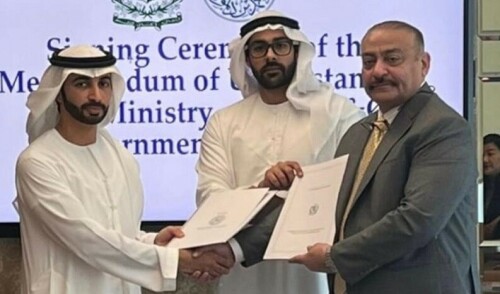
According to a statement, a delegation comprising Ahmed bin Dalmook bin Juma Al Maktoum, a member of Dubai’s ruling family, Hayat BioTech Chief Operations Officer Naser Ali Khameis Alyammahi and others visited Pakistan to meet Prime Minister Shehbaz Sharif, Health Minister Abdul Qadir Patel and others to discuss new ventures in the fields of health, vaccine and research, including plasmapheresis, and investment in vaccine development in the country.
Sheikh Maktoum inaugurated a coordination office at the Regional Blood Centre, Islamabad, which will establish close liaison with the firm and the ministry. The statement added that the delegation was ready to invest in plasma farming in Pakistan based on WHO standards, as the blood services in the country were provided mainly by hospital blood banks with no functional separation of the plasma processes into production and utilisation.
Health Minister Abdul Qadir Patel said Pakistan highly valued its relations with the UAE, adding that collaboration between the two nations in the field of health will be of immense benefit to the people of Pakistan.
UAE delegation meets PM, opens coordination office
“Recent collaboration between the two states and the special interest of our brotherly state on this very significant health agenda regarding reforms in blood banking services by setting up a plasma farming and harvesting facility in Pakistan would play a crucial role in the delivery of quality healthcare,” he said.
Sheikh Maktoum said that the UAE was fully committed to supporting the development, implementation and expansion of the project in Pakistan.
“Pakistan and UAE have laid strong foundations of mutually beneficial relations, friendship and peaceful cooperation over the years and the UAE is keen to invest in different sectors of the Islamic Republic of Pakistan, especially in the health field,” he said.
Hayat Biotech, one of the leading biotechnology companies in the Middle East and North Africa (MENA) region, is formalising joint efforts with the health ministry and the office of Sheikh Maktoum for the establishment of a state-of-the-art plasma collection centre in Islamabad.
Senior officials from both entities recently met Prime Minister Sharif to discuss details about the launch of the project, deployment of joint teams and the way forward. The prime minister lauded their efforts regarding investment in the health sector.
Plasma shortage
Plasma shortage is fast becoming a global concern with a 20pc drop in plasma donations between 2020-2021 and a growing demand for plasma-based therapies.
Plasma is the primary component used in manufacturing plasma-derived pharmaceutical products which treat a wide spectrum of rare, chronic and potentially life-threatening health conditions. The plasma collection sector is growing at a tremendous rate, and Pakistan’s patient population is heavily reliant on plasma-based therapies for both survival and improved quality of life.
Globally, there has been a decline in plasma supply due to Covid-19. During the pandemic, plasma collection has fallen drastically primarily due to concerns from donors about visiting collection centres.
To overcome the supply issues, Hayat Biotech is working closely with the NHS ministry in Pakistan to address the national shortage by establishing an end-to-end plasma collection entity within the country.
A spokesperson for the health ministry, Sajid Shah, while talking to Dawn, said hundreds of thousands of patients had been suffering from immunodeficiency disorder in Pakistan and buying medicines for them was next to impossible.
“It is a significant development as Pakistan does not have even a single PFF even though there are a few hundred thousand patients suffering from immunodeficiency disorder,” he said.
He said the term used to split blood components is called “plasma fractionation” since blood is initially divided into three components - platelets, red blood cells, and white blood cells.
“Plasma contains a number of proteins, while the absence of those proteins becomes a reason for the immunodeficiency disorder. While in developed countries, those components are separated from plasma and administered to patients, in Pakistan there is no such facility due to which patients have to import medicines or those proteins from abroad at very exorbitant rates,” he said.
Published in Dawn, April 2nd, 2023