ISLAMABAD: Prime Minister Shehbaz Sharif had during his recent trip to the United Arab Emirates asked Emirati President Mohamed bin Zayed Al-Nahyan to facilitate dialogue with India and vowed sincere talk with the arch rivals, if a channel were to open.
Mr Sharif, in an interview to Al-Arabiya news channel, confirmed that he had sought Al-Nahyan’s help for the dialogue, while noting that Pakistan had “learnt its lesson” and “was ready for peace”.
“I have requested Mohammed bin Zayed — that he’s a brother of Pakistan and the UAE is a brotherly country. He also has good relations with India, he can play a very important role to bring the two countries on the talking table and I give my word of honour that we will be talking to Indians with sincerity of purpose,” he said.
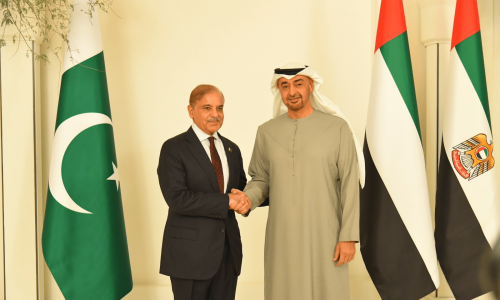
The prime minister met Mr Al-Nahyan on Jan 12 in Abu Dhabi during his two-day visit to the UAE. The visit, Mr Sharif’s third to the UAE since assuming office in April, was focused on promoting bilateral economic, trade, and investment ties.
Recalling the three wars with India and the resulting toxicity in ties and sufferings that were caused to the people, Mr Sharif told the interviewer that “we have learnt our lesson” and wanted to live in peace. However, he conditioned that offer to the resolution of “genuine problems”. He specifically noted the Kashmir dispute.
“My message to the Indian leadership and Prime Minister Narendra Modi is that let us sit down on the table and have serious and sincere talks to resolve our burning issues like Kashmir,” he said while reminding about the continuing “flagrant human rights violations” in the occupied region, and the 2019 revocation of the Kashmir’s autonomy.
He also recalled the persecution of minorities in India. “India must stop this to give a message to the world that the country was ready for talks,” Mr Sharif said while underscoring that Pakistan was “more than willing” for peace.
The prime minister’s spokesman later, through a tweet, reminded that it has been Mr Sharif’s consistent position that talks won’t be possible till India reversed its “illegal action of August 5, 2019” and that the settlement of the Kashmir dispute must be in accordance with the UN resolutions and aspirations of people of Jammu and Kashmir.
Interestingly, notwithstanding the prime minister’s emphasis on the centrality of Kashmir dispute in any dialogue with India, including one potentially facilitated by the UAE, the word Kashmir was conspicuously absent from the UAE-Pakistan joint statement issued at the end of the two-day official visit.
The UAE boasts strong ties with India. Al-Nahyan’s foreign policy adviser Anwar Gargash, while speaking at India Global Forum held in the UAE in December, said the two countries hold “reservoir of trust”.
Indian External Affairs Minister S. Jaishankar had on that occasion said India and the UAE would play a significant role in reshaping the global order.
Abu Dhabi has in the past played its part in defusing Pakistan-India tensions. Its quiet role in preventing the situation from spiraling out of control during the Balakot stand-off is well known.
Emirati envoy in Washington Yousef Al Otaiba had in 2021 acknowledged that his country had helped in managing escalation over Kashmir.
There was no immediate word from Delhi on Mr Sharif’s remarks. It remains to be seen how seriously would Delhi take Mr Sharif’s offer for a dialogue in an election year.
Published in Dawn, January 18th, 2023