GB’s land issue

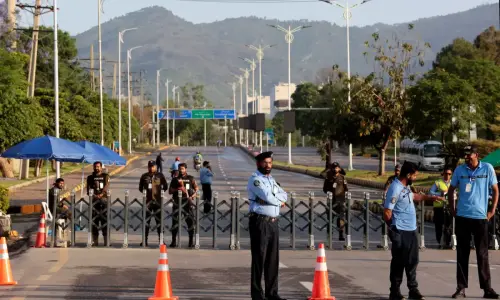
THE demonstrations that erupted in Gilgit-Baltistan at the end of 2022 have entered the new year. The mass protests against electricity shortages, reduction in the wheat quota, taxation and alleged land grabbing by the state are being led by the Awami Action Committee — an alliance of various political, religious and trade associations.
From 2015 onwards, there has been considerable contestation over GB’s land between the state and the people. Locals argue that the land belongs to GB’s people, as the region is disputed and has not yet been constitutionally integrated into Pakistan. However, the district administration maintains that the land that has not been transferred to any individual belongs to the Pakistani state.
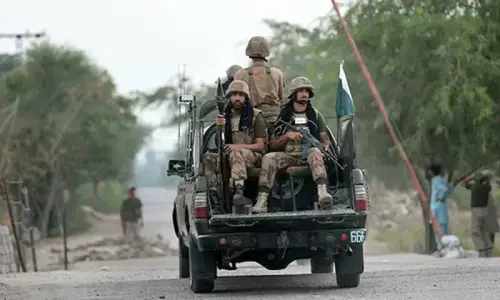
The issue of land has persisted for decades. It acquired greater urgency after 2015, when the state started obtaining more and more land in the name of development and security for CPEC. The most recent incident that triggered the mass protests took place when the people of Minower, Gilgit, stopped the state from demolishing the boundary walls surrounding the land claimed by them and other infrastructure they had built. They are demanding compensation for the land given to state institutions and cancellation of illegal allotments to land mafias. Images and videos of protesters stopping tractors and arguing with security forces were circulated recently on social media.
In the early 19th century, the Sikh empire — with its seat of power in Lahore — occupied Kashmir and started expanding in the direction of Baltistan and Ladakh. Gulab Singh Dogra extended the empire towards the north, capturing Ladakh and Baltistan and annexing Skardu to Jammu. In the late 19th century, the Sikh rulers tried to settle the land in Skardu, Astore and Gilgit. The cultivatable, revenue-generating land was allotted to the people. The Dogra rulers collected the revenue while the land ownership was maintained by the Sikh government. In 1914-16, the Dogras, facing difficulty in revenue collection, provided cultivated land to the local rulers, or rajas, to collect revenue and give it to the state as taxation. The remaining land was considered shamilaat (common property) of the villages.
Residents in GB are demanding compensation.
The Dogra rulers also implemented the State Subject Rule in Kashmir, barring outsiders from buying Kashmiri land or getting a domicile and getting jobs. When Maharaja Hari Singh signed the Instrument of Accession, Kashmir was given special status in the Indian constitution. But on Aug 5, 2019, Indian Prime Minister Narendra Modi revoked Articles 35-A and 370, ending Kashmir’s autonomy and abolishing the SSR.
After GB’s independence, successive Pakistani governments gave little importance to the barren land over there. When Bhutto abolished the local feudal system and brought land reforms in the 1970s, GB residents paid an amount of money devised by the government at the time to obtain ownership. The government also compensated local rajas through remuneration and land. It was during Gen Zia’s military regime that the nautor rule was introduced, violating the Land Revenue Act of 1967. It was enforced in 1979 to regulate the land. According to Basharat Ghazi, a civil rights activist and lawyer, a procedure to transfer the land was defined. Under Section 11 of this rule, after the application, verification and payment of a certain amount, the land would be transferred to the residents. In the 1980s, another order was issued by the government, banning all kinds of transfers and allotment. Since then, the remaining land has been claimed by the government as its own. GB’s lawyer fraternity, however, differs with this stance in the light of UN resolutions on Kashmir.
The common land in GB has been used by the people for livestock grazing, collecting firewood, etc since Dogra rule — in fact, for centuries before that, the locals claim. Interestingly, in the Land Revenue Act, which was extended to GB, this common land is not shown as government land. With the rise in population and the sudden spike in prices, the value of land increased manifold and the conflict between the state and the people started.
Ehsan Ali, former president of the GB Supreme Appellate Court, has criticised the nautor rule as violative of the Land Revenue Act and as an attempt to seize the people’s land through land mafias. He has also criticised the violation of SSR, arguing that a “rule is not law. A law is repealed through another law, but no law repealed SSR, and it is violated by different governments and regimes”.
GB’s land issue is grave. Local leaders have so far been unable to take a united stand. The federal government of Pakistan should show a commitment to resolving the land issue. The solution lies in politically engaging with the local communities and addressing their grievances.
The writer is a fellow of the Centre for Business and Economic Research and faculty at IBA, Karachi.
Twitter: saj_ahmd
Published in Dawn, January 5th, 2023