The Foreign Office on Wednesday said that Indian media’s reports about the International Atomic Energy Agency (IAEA) director general (DG) calling the BrahMos missile incident “not a cause of specific concern” were a “disingenuous attempt” to absolve India of its “irresponsible nuclear behaviour”.
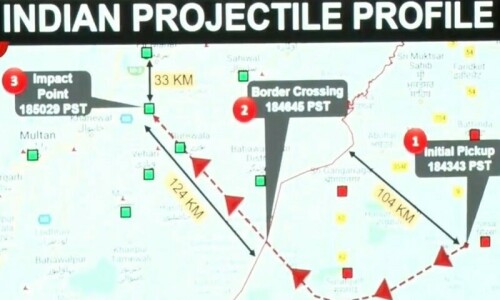
The BrahMos missile — a nuclear-capable, land-attack cruise missile jointly developed by Russia and India — was fired into Pakistan territory on March 9, prompting authorities to seek answers from New Delhi on the safety mechanisms in place to prevent accidental launches.
In a report on November 14, The Indian Express quoted international nuclear watchdog IAEA as saying that it did not see the incident as any cause of “specific concern”.
In an interview with The Indian Express at COP27 climate change conference, IAEA DG Rafael Mariano Grossi said that the watchdog didn’t seek any information from the Indian government on the incident.
“We are constantly looking at all the situations around the world and of course, we look with interest when a very important member state of the IAEA has issues. But it (the BrahMos incident) was never an issue of any specific concern for us,” the report quoted Grossi as saying.
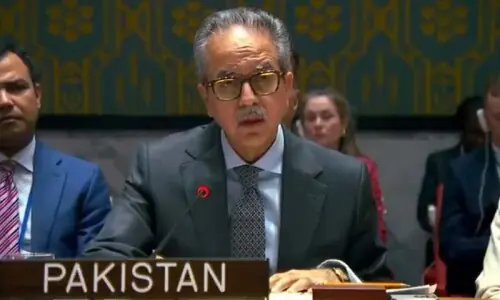
Responding to the development today, FO spokesperson Mumtaz Zahra Baloch said that the report should have “been qualified by stating that IAEA has no mandate on such matters”.
“The DG’s response cannot be purposely misinterpreted to trivialise the incident of a nuclear-capable BrahMos missile fire with grave implications for regional and global security.
“The incident has raised several questions about India’s conduct as a nuclear state, including whether it was actually an accident. India also needs to answer questions about the underlying intentions, technical features and reliability of the missile system, safety, security and nuclear command and control protocols, and the presence of rogue elements in the Indian military,” the FO spokesperson said.
She added that India needed to explain “several repeated incidents” of nuclear and radioactive material theft and illicit trafficking, saying that they were more relevant to the IAEA mandate.
Baloch went on to say that India was expected to report these nuclear security-related incidents under the IAEA Incidents and Trafficking Database.
“These critical questions, which remain unanswered, should continue to be of concern to the international community.”
Tension over the incident
After the incident was reported, the FO had summoned the Indian envoy to register a protest over the unprovoked violation of its airspace, saying such “irresponsible incidents” reflected the neighbouring country’s “disregard for air safety and callousness towards regional peace and stability”.
It also called for a thorough and transparent investigation of the incident, the results of which should be shared with Pakistan.
The Indian defence ministry had subsequently shared that the incident was “deeply regrettable” and attributed the “accidental firing” to a “technical malfunction”. Following India’s admission, Islamabad had questioned why New Delhi failed to immediately share information about the incident and acknowledged the occurrence only after Pakistan announced it, seeking clarification.
The FO had taken note of India accepting the missile accident, saying that the matter could not be addressed through the “simplistic explanation” by India and had listed a set of questions and issues in this regard, which it had said must be answered by the Indian authorities.
The United States had also later chimed in, saying that it had “no indication” that the missile launch was “anything other than an accident”.
The Indian Air Force said in August that the government had sacked three officers over the incident but the FO subsequently rejected India’s “purported closure” of the inquiry and reiterated the demand for a joint probe into the incident.