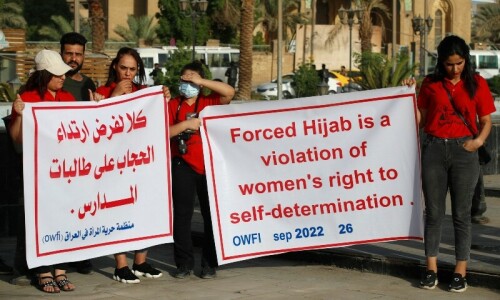
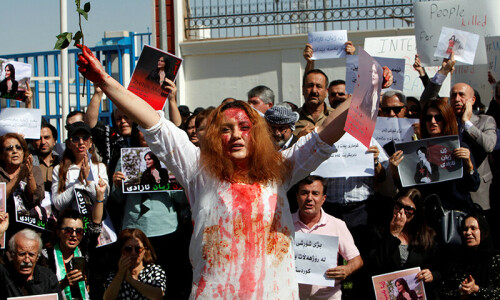
Iranians take to streets for 12th night of women-led protests
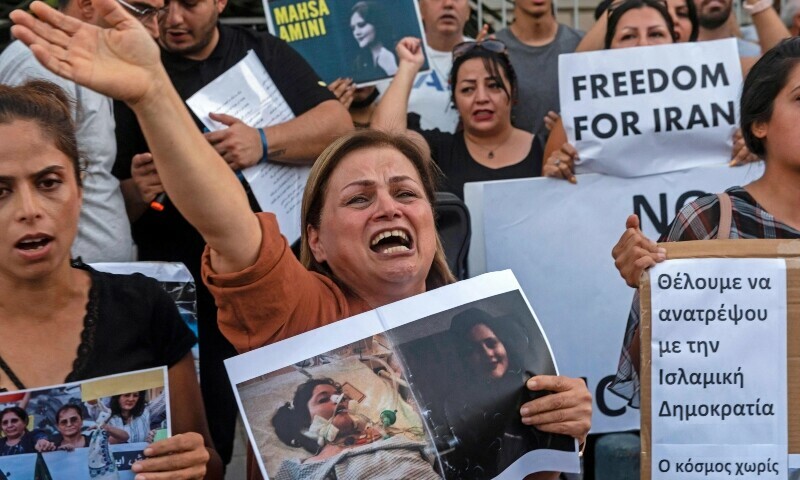

Iranians on Tuesday staged a 12th straight night of protests over the death in custody of Mahsa Amini, in defiance of a crackdown that a rights group says has killed more than 75 people.
The women-led demonstrations flared after the 22-year-old Kurdish woman died in the custody of the notorious morality police for reportedly not observing the Islamic republic's strict dress code.
Opposition media based abroad said widespread protests continued in different cities, but activists said internet restrictions were making it increasingly tough to get video footage out.
A woman is shown with her headscarf removed and waving her arms in the air in the Tehran district of Narmak, in a video shared by Manoto television channel, which also reported a protest in the southern port city of Chabahar.
Women are seen removing headscarves at Sanandaj, in Amini's home province of Kurdistan, and a man torches a banner of Iran's supreme leader Ayatollah Ali Khamenei in the southern city of Shiraz, in reports by London-based Iran International TV.
“Iran remains under internet/mobile blackouts but some videos are still getting out,” the New York-based Center for Human Rights in Iran said.
Iran's semi-official Fars news agency said “around 60” people had been killed since Amini's death on September 16, up from the official death toll of 41 authorities reported on Saturday.
But the Oslo-based group Iran Human Rights (IHR) said at least 76 people have been killed in the crackdown.
Officials said Monday they had made more than 1,200 arrests. Those taken into custody have included activists, lawyers and journalists as well as protesters.
Health Minister Bahram Einollahi, quoted by the official news agency IRNA, accused the protesters of destroying 72 ambulances, while activists based abroad say the authorities have been using ambulances to transport security forces.
Tensions with West
The crackdown has drawn condemnation from around the world.
On Tuesday, US think-tank Freedom House joined the chorus and called on “other governments to stand with these courageous protesters and hold Iranian officials to account for their abuses”.
Tensions with Western powers have grown this week, with Germany summoning the Iranian ambassador, Canada announcing sanctions and Tehran calling in the British and Norwegian envoys.
“We call on the international community to decisively and unitedly take practical steps to stop the killing and torture of protesters,” said IHR's director Mahmood Amiry-Moghaddam.
Video footage and death certificates obtained by IHR showed that “live ammunition is being directly fired at protesters”, he charged.
Riot police in black body armour have beaten protesters with truncheons in running street battles, and students have torn down large pictures of Khamenei and his late predecessor Ayatollah Ruhollah Khomeini, in recent video footage published by AFP.
At least 20 journalists have been arrested, according to the Committee to Protect Journalists.
Mahsa Alimardani, senior Iran researcher for freedom of expression group Article 19, said the internet blackout was as bad as during deadly November 2019 protests that erupted over fuel price rises.
“Content has stopped coming out as it used to. Pockets of access we had to Iran seem to be gone. This is a really frightening prospect for even more bloodshed,” she said.
'Demands of the people'
The Iranian judiciary chief, Gholamhossein Mohseni Ejei, has stressed “the need for decisive action without leniency” against the protest instigators.
But a powerful Shiite cleric long aligned with the country's ultra-conservative establishment has urged authorities to take a softer line.
“The leaders must listen to the demands of the people, resolve their problems and show sensitivity to their rights,” said Grand Ayatollah Hossein Nouri Hamedani.
Western condemnation of the bloody crackdown has clouded diplomatic efforts to revive a nuclear deal between Iran and major powers that was abandoned by then US president Donald Trump in 2018.
The EU's foreign policy chief Josep Borrell, who has led those efforts, on Sunday slammed Iran for its “widespread and disproportionate use of force against non-violent protesters”.
The United States last week imposed sanctions against the Iranian morality police, and Canadian Prime Minister Justin Trudeau said on Monday his own country would follow suit with a sanctions package “on dozens of individuals and entities”.