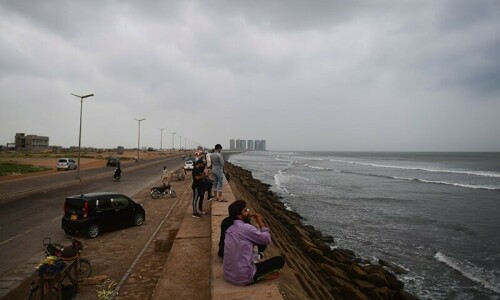
KARACHI: In what appeared to be among the most disastrous monsoon spells in six decades, Sindh and Balochistan are witnessing the heaviest rainfall since 1961, as the two provinces recorded 522 and 469 per cent, more than the normal downpour this year, respectively.
The fresh numbers came from the Met Office, which surprised officials and attracted warnings from environmentalists, who called it the beginning of fresh challenges for the authorities as the much-hyped climate change had finally come knocking.
“Sindh has received 680.5 millimetres of rain since July when the monsoon season actually began,” said a Met official.
“As per calculated and defined standards, Sindh normally gets 109.5mm rains in the monsoon season. So it’s 522pc higher than normal. Similarly, Balochistan receives 50mm rain on an average every monsoon, but it has so far recorded 284mm — 469pc higher. The country has overall witnessed 207 times higher rainfall so far this monsoon and the season is going to last till September-end.”
Padidan, a town in Naushero Feroze district, has so far received 1,722mm rain since July, the official said, stressing that figure was never recorded in any Sindh town, ever. He then referred to data that suggested Sindh and Balochistan had last witnessed such torrential rains in 1994, which was recorded as the heaviest since 1961.
“In 1994, Sindh had received 502.6mm rain, which was 276pc higher than the normal count as per calculations in those times based on environmental and climate modules. The same year, Balochistan had received 175mm rain, which was 52pc higher than its normal count,” he explained.
In other parts of the country also, the situation didn’t look so different this year. Gilgit-Baltistan, according to the Met Office data, has so far received 50.3mm rain in two months, which is 99pc above normal and Punjab 349mm, exactly 90pc higher than its normal downpour in monsoon. Khyber Pakhtunkhwa witnessed 31pc above normal rain this monsoon, where so far 257.4mm rains have been recorded.
Read: Pakistan declares emergency in the face of calamitous floods
Azad Jammu and Kashmir is the only region in the country that has witnessed below average downpour this monsoon. The valley has recorded 279.6mm rain, which is minus 7pclesser than its normal monsoon downpour. The situation has set alarm bells ringing, as the authorities and experts are convinced that climate change is no longer an approaching challenge, but “is happening right now”.
“The impacts of climate change have started emerging,” said Dr Ghulam Rasul, former director general of the Pakistan Meteorological Department. “What we are seeing now is actually part of those series of events that had started emerging for quite some time. For instance, spring in Pakistan is almost eliminated. We didn’t see spring this year. After a very harsh winter, we jumped into a very severe summer with one after another heatwave even in rural areas.”
He called the massive and “disastrous rains” as the reasons behind the flooding in Sindh and Balochistan and not the infrastructure soil condition. In Balochistan, he said, the hilly soil could have been one of the reasons that aggravated the flood situation as the water could not be absorbed by such a surface. But that couldn’t be called a reason in any part of Sindh, he added.
“Another challenge which makes this climate issue more challenging is the growing population and the fast shrinking space for a better and environment-friendly ecosystem,” said Mr Rasul.
“The population is growing so fast that our agricultural land is being used for urban settlement and construction. You can gauge the severity of the issue with simple data that in 1951, 5,500 cubic metres water was available in Pakistan for one person. The number has now shrunk to 850 cubic metres.”
Published in Dawn, August 26th, 2022