On navy day, Putin says United States is main threat to Russia


President Vladimir Putin on Sunday signed a new naval doctrine which cast the United States as Russia's main rival and set out Russia's global maritime ambitions for crucial areas such as the Arctic and the Black Sea.
Speaking on Russia's Navy Day in the former imperial capital of St Petersburg founded by Tsar Peter the Great, Putin praised Peter for making Russia a great sea power and increasing the global standing of the Russian state.
After inspecting the navy, Putin made a short speech in which he touted Russia's unique Zircon hypersonic cruise missiles. He cautioned that Russia had the military clout to defeat any potential aggressors.
Shortly before the speech, he signed a new 55-page naval doctrine, which sets out the broad strategic aims of Russia's navy, including its ambitions as a "great maritime power" which extends over the entire world.
The main threat to Russia, the doctrine says, is "the strategic policy of the USA to dominate the world's oceans" and the movement of the Nato military alliance closer to Russia's borders.
Russia may use its military force appropriately to the situation in the world's oceans should other soft powers, such as diplomatic and economic tools, be exhausted, the doctrine says.
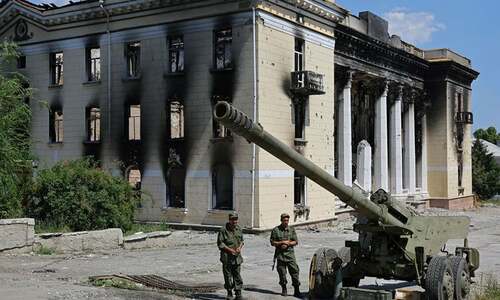
Putin did not mention the conflict in Ukraine during his speech but the military doctrine envisages a "comprehensive strengthening of Russia's geopolitical position" in the Black and Azov seas.
It also set out the Arctic Ocean, which the United States has repeatedly said Russia is trying to militarise, as an area of particular importance for Russia.
Russia's vast 37,650-kilometre coastline, which stretches from the Sea of Japan to the White Sea, also includes the Black Sea and the Caspian Sea.
Putin said the delivery of Zircon hypersonic cruise missiles to the Admiral Gorshkov frigate would begin within months. The location of their deployment would depend on Russian interests, he said.
"The key thing here is the capability of the Russian navy ... It is able to respond with lightning speed to all who decide to infringe on our sovereignty and freedom."
Hypersonic weapons can travel at nine times the speed of sound, and Russia has conducted previous test launches of the Zircon from warships and submarines over the past year.
In Crimea, Sevastopol governor Mikhail Razvozhayev said Ukrainian forces struck the headquarters of Russia's Black Sea Fleet in the Russian-held port city early on Sunday, wounding five members of staff.