Pakistan countering ‘West-backed’ Indian military build-up: National Command Authority aide
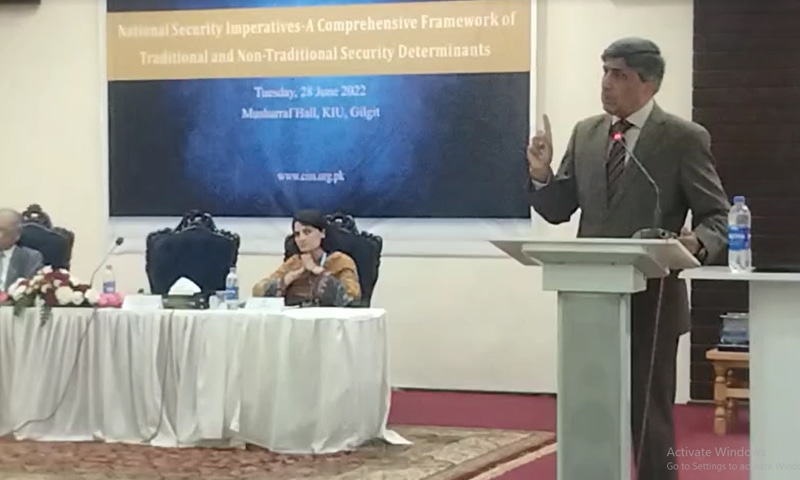


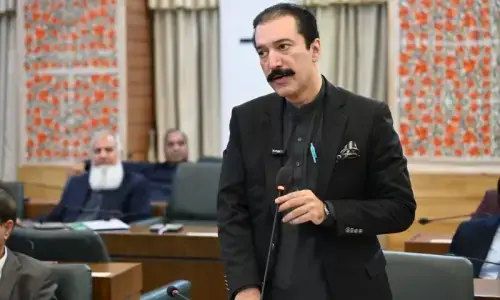
GILGIT: Adviser National Command Authority retired Lt Gen Mazhar Jamil said on Tuesday that Western support to India was allowing it to build its conventional and nuclear arsenals, and that Pakistan had no choice but to take countermeasures against Indian attempts to create an imbalance in the region and launch a military misadventure.
He was speaking at a ‘National Security Imperatives — A Comprehensive Framework of Traditional and Non-Traditional Security Determinants’, a seminar hosted by the Center for International Strategic Studies (CISS) in collaboration with Karakoram International University.
Lt Gen Jamil said that Pakistan wants peace, internally and externally. For this, it is willing to work with India for the resolution of all outstanding disputes, including the core issue of Jammu and Kashmir, on the basis of the principle of equality.
In his keynote address, Lt Gen Jamil said that Pakistan was facing numerous security challenges, both traditional and non-traditional, which needed to be addressed comprehensively.
Retired Lt Gen Jamil says Islamabad willing to work with New Delhi for sake of peace, onus now on India
“Pakistan cannot isolate itself from global power politics and we must build our national power potential without getting consumed by the great-power competition. Economic and military security are intertwined, and without a robust traditional and non-traditional security framework, it would remain hollow,” he said.
According to a statement issued after the event, he said the US-led western bloc was supporting Indian military build-up while also providing New Delhi access to advanced nuclear technologies and materials, in blatant disregard for international norms and commitments of the non-proliferation regime.
Stressing that India’s Hindu nationalism and religious extremism was being implicitly supported by western patrons, Lt Gen Jamil said that this support was making India a highly irresponsible nuclear power.
It has been witnessed in the past decade and a half that any political or military support that New Delhi receives, it tends to use it against Pakistan while presenting itself as a counterweight against China, he said.
He contended that in the face of India’s growing military capability and aggressive doctrines, Pakistan had no choice but to take countermeasures to contain any Indian attempt to create an imbalance in the region and launch a military adventure.
As a responsible nuclear state, Pakistan seeks strategic stability and shall maintain its full spectrum deterrence, while remaining open to exploring bilateral arms control mechanisms with India to reduce nuclear risks and prevent war. The onus of responsibility lies on India to take appropriate measures to create an enabling environment for resolution of disputes and for enduring peace and stability in the region, he concluded.
CISS Executive Director Ambassador Ali Sarwar Naqvi said, “Pakistan’s success in harnessing the peaceful atom for socio-economic development has earned it the respect and recognition of the International Atomic Energy Agency (IAEA).”
“I was a personal witness to the IAEA’s favourable view of Pakistan when I was ambassador to the agency in Vienna,” said Ambassador Naqvi.
Zafar Iqbal of the Space and Upper Atmosphere Research Commission said that SUPARCO is emphasising the integrated use of space applications and available enabling technologies as a mainstream tool in development planning both at federal and provincial levels.
“For this purpose, a Space Applications and Research Centre is being established in Gilgit-Baltistan, which would be fully operational in spring of next year,” he said.
Former Pakistan Atomic Energy Commission chairman Dr Ansar Pervez said that the commission was playing a significant role in the socioeconomic development of the country and contributing to at least 11 of the 17 United Nations Sustainable Development Goals (SDGs).
Pakistan is also increasing its reliance on clean energy alternatives, he said, adding that the country was on its way to building more nuclear power plants to overcome future energy needs.
Published in Dawn, June 29th, 2022