Pakistan, Afghanistan agree on forming border committee as NSA Moeed Yusuf wraps up Kabul visit



Pakistan and Afghanistan have agreed to form a high-level committee to address border issues as National Security Adviser (NSA) Moeed Yusuf concluded a two-day visit to Kabul.
The development comes weeks after videos circulated on social media purportedly showing Taliban fighters uprooting a portion of the fence along the Pak-Afghan border.
Editorial: It is clear that any change in the status of Pak-Afghan border is unacceptable to Pakistan
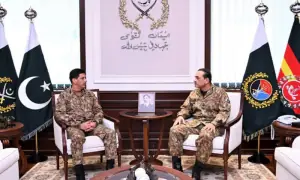
During the visit, the NSA — who also heads the Afghanistan Inter-Ministerial Coordination Cell (AICC) — called on Afghanistan Acting Deputy Prime Minister Mullah Abdul Salam Hanafi and Acting Foreign Minister Amir Khan Muttaqi to "discuss the current situation in Afghanistan and strengthening of bilateral relations between the two countries", an official statement said.
“Both sides agreed to establish a national-level coordination mechanism for enhancing facilitation at border crossing points and to expedite ongoing negotiations to conclude a new trade agreement,” the statement said which was shared on Twitter by Pakistan's ambassador in Kabul, Mansoor Khan.
The 2010 Afghanistan-Pakistan Transit Trade Agreement (APTTA) expired on February 11, but both sides have not yet reached a new agreement.
The statement went on to say that the objective of the visit was to discuss with the Afghan leadership the humanitarian requirements of the country and "Pakistan’s proposals for deepening economic engagement to overcome the current challenges Afghanistan is facing".
It added that Special Envoy for Afghanistan Ambassador Muhammad Sadiq and senior officials from relevant ministries were part of the delegation that accompanied the NSA.
Yusuf also held delegation-level meetings with Afghan ministers and senior officials dealing with humanitarian and economic issues.
"The visit yielded substantive outcomes in terms of forward movement on trade facilitation and social sector support [...] both sides also agreed to initiate barter trade, modalities for which will be worked out immediately," the statement said.
During the visit, Pakistan offered Afghanistan capacity-building and training support in multiple sectors including health, education, banking, customs, railways and aviation.
The statement said both sides also reiterated their commitment to the early completion of three major connectivity projects: the Central Asia South Asia Electricity Transmission and Trade Project (CASA-1000), the Turkmenistan-Afghanistan-Pakistan-India gas pipeline (TAPI), and Trans-Afghan Rail project.
"Afghanistan and Pakistan emphasised their commitment to ensuring peace and stability in both countries. Dr Yusuf thanked the interim Afghan government for their warm hospitality," the statement concluded.
Meanwhile, Ambassador Khan said that the NSA and the Pakistani delegation also visited Jinnah Hospital in Kabul that was built by Pakistan.
"The delegation saw its facilities and current operations. The Jinnah Hospital director apprised [them] about challenges [being faced] due to the financial situation," he said, adding that Pakistan reiterated its continued support to the hospital.