Ex-GB judge Rana Shamim submits contentious affidavit in IHC more than a month after it was published


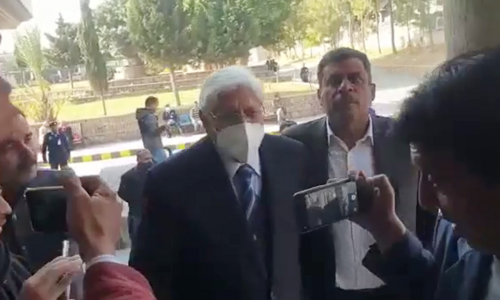
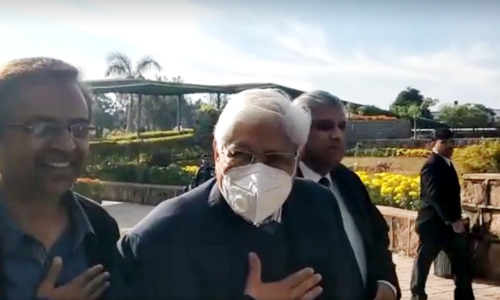
Former Gilgit-Baltistan chief justice Rana Shamim on Monday submitted in the Islamabad High Court (IHC) his original affidavit — in which he reportedly accuses fellow former jurist Mian Saqib Nisar of collusion to deny bails to top PML-N leadership prior to the 2018 general elections — more than a month after the affidavit was mentioned in an investigative report in The News.
In the last hearing on December 13, the IHC had deferred the framing of charges in a contempt of court case against the ex-judge and three others and again directed Shamim to submit the original affidavit, having previously directed him to submit it in hearings on November 30 and December 7.
In a written order on December 10, IHC Chief Justice Athar Minallah had warned that charges would be framed if the maker of the affidavit, Shamim, the publisher and editor-in-chief of Jang Group Mir Shakeelur Rehman, senior journalist Ansar Abbasi and resident editor Amer Ghouri failed to show it was executed and published for bona fide purpose.
Justice Minallah had issued the order after going through the reply submitted by Shamim in which he explained reasons for executing the statement on oath — dated November 10, 2021.
In the 'leaked' affidavit, on which Ansar Abbasi's report was based, Shamim allegedly stated that Nisar during his visit to GB made a call to an IHC judge and asked him to ensure that former prime minister Nawaz Sharif and his daughter Maryam Nawaz are not released on bail before July 25, 2018 general elections. The affidavit was published as part of an investigative report by The News on Nov 15.
Justice Minallah had subsequently taken notice of the report and later issued show-cause notices to Abbasi, Rehman, Ghouri as well as Shamim under the Contempt of Court Ordinance.
During today's hearing, the additional attorney general informed the court that Attorney General Khalid Jawed Khan was admitted in Aga Khan University Hospital and would return by Thursday.
Meanwhile, Lateef Afridi, Shamim's legal counsel, informed the court that the affidavit had been submitted to the IHC and the former judge has been "standing by his statement since the first day".
"The real affidavit was sealed and has now been brought to Pakistan on the court's order," he said.
Justice Minallah said the sealed envelope was in its original condition and had not been opened by the court yet.
"The attorney general had said the media's role is secondary. Rana Shamim has admitted that the content published in the newspaper (The News report) is [the same as] in his affidavit. Rana Shamim has cast doubt on all judges of the IHC," the chief justice said, adding that the court had already made it clear that it did not fear criticism.
Justice Minallah then turned to Shamim's counsel and asked him to open the envelope, upon which the counsel said that a new inquiry could be started by opening a sealed envelope.
"This is an open inquiry. This is our accountability," the judge said. He added that Shamim had apparently made "a very big statement without any evidence" and given an impression that all IHC judges were "compromised".
Afridi said his client maintained that he did not "leak" the affidavit.
"Can a finger be pointed at any judge of this court? The court will not ask the journalist about the source of his news. This court is hearing many important cases related to fundamental rights," Justice Minallah remarked.
The judge called for evidence to be presented regarding the public opinion that was being built, saying the public's trust in the court should not be eroded.
"This court will not deviate from the law," Justice Minallah remarked. He added that the next hearing would be held on Thursday. However, Afridi said he would not be able to attend the hearing on that date.
Pakistan Federal Union of Journalists (PFUJ) secretary general Nasir Zaidi, who is an amicus curiae in the case, told the IHC that freedom of expression could not be considered contempt of court.
Justice Minallah observed that freedom of expression was one of the most important fundamental rights — which the court had also mentioned in its judgements — but the situation was different when freedom of expression was not in the public interest.
Subsequently, Afridi requested the court to adjourn the hearing until after winter vacations were over. However, Justice Minallah observed that the IHC had not issued any notification about vacations.
The hearing was adjourned till December 28.