Tsunami strike on coastal areas a probability, fear experts


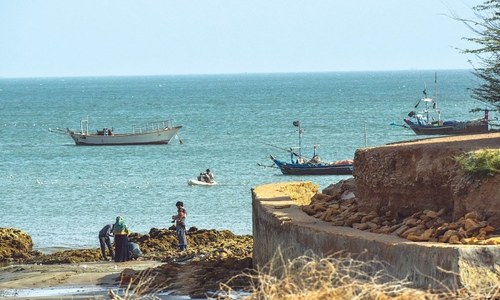
KARACHI: The Met authorities and experts of disaster management on Thursday warned that it was almost imminent that tsunami would hit the coastal belt of Sindh and Balochistan.
According to them the tsunamigenic earthquake fault zone in sea has completed its “time scale and return period” after triggering a disaster first in 1945 impacting mainly the Makran coastal belt.
The warning came during a briefing attended by experts and officials at ‘Stakeholders’ workshop on mitigating tsunami risk’ at a local hotel.
At the inaugural session of the workshop, Pakistan Meteorological Department (PMD) director general Muhammad Riaz came up with the warning and some suggestions to meet the approaching challenge. “What is needed to do is to establish a strong early-warning system and make people more aware about the required response in such a situation,” he said.
According to him, Pakistan is prone to hazards in terms of natural disasters. “You would find here torrential rains in a short period of monsoon which leads to flooding. But one specific system is more intense, challenging and deadly which is active along the Sindh-Makran coast. We have tsunamigenic earthquake fault zone here which can trigger [a disaster] anytime. This is called Makran subduction zone and it is the most vulnerable area which can produce earthquake and tsunami anytime.”
Mr Riaz said the active faultline was found only 40 kilometres from the Pakistan’s coast and if it generated a tsunami or earthquake, it would take hardly five minutes to hit the towns along the coastal belt.
“Our models and some softwares suggest that tsunamigenic earthquake fault zones under Makran subduction zone would have only five or maximum 30 minutes to trigger. Its travelling time is too short.”
It would be very difficult and challenging to cope with the situation if developed, said Mr Riaz. “It was in 1945 when there was a tsunamigenic earthquake in this fault zone,” said the PMD director general. “It had mainly hit the Makran coast and caused a disastrous damage. After more than 75 years, it has completed its natural timescale and return period to trigger again anytime -- maybe now or tomorrow; or maybe a year later or after 10 years.”Provincial Disaster Management Authority (PDMA) director general Syed Salman Shah said that in continuation of this project, his organisation was also installing 14 additional tsunami warning posts along the Karachi coast. The PDMA, he said, in collaboration with PMD was taking keen interest in the training of local communities and capacity-building of the response agencies.
United Nations Development Programme (UNDP) project coordinator Naeem Iqbal informed the audience that soon after the 2005 earthquake in Pakistan, the UN body had started investment in honing capacity of the PMD, PDMA and other agencies.
Published in Dawn, October 15th, 2021