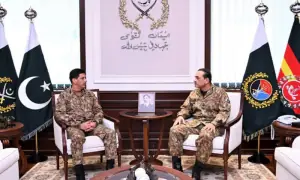
THE change of command at the ISI has become a subject of intense media coverage and discussion. The military on Wednesday notified a number of important transfers and postings that included the appointment of a new director general of the ISI. Lt Gen Nadeem Ahmad Anjum has replaced Lt Gen Faiz Hameed who will now command the corps in Peshawar.
The breathless wall-to-wall commentary on these appointments is a sad reflection on the state of affairs in the country where such appointments have acquired a larger-than-life image because of the oversized role that the establishment plays in the affairs of the state. In normally functioning democracies, the discussion on the appointments in intelligence agencies revolves around the professionalism of the officers tasked with the responsibility and the challenges that lie ahead for them. In Pakistan, sadly the debate is focused on the political impact of such appointments and how the new person would approach these aspects which have over the years become part and parcel of intelligence work.
It is no secret that the agencies have been actively involved in political affairs in the past. The formation of the IJI, a political alliance cobbled together after the death of military ruler Gen Ziaul Haq, was the handiwork of such agencies and this has now been officially acknowledged in front of the Supreme Court. The agencies also played a role in the events surrounding the issue of former army chief Gen Raheel Sharif’s extension. They were also major players in handling matters relating to the Tehreek-i-Labbaik Pakistan. These are just a few of the numerous examples that portray how the agencies continue to shape and influence matters that are outside their official purview. The latest appointment, and the frenzy surrounding it, is a reminder to all citizens, and especially those in decision-making positions, that Pakistan must strive to move beyond a state of functional existence where clearly defined institutional boundaries and limitations are cast aside with impunity at the altar of some vague expediency.
The new chief at the ISI has his work cut out for him. There are major challenges facing Pakistan around its borders and the agencies should be focusing all their attention, energies and resources on scuttling such external threats to the country. The volatile situation in Afghanistan in wake of the Taliban takeover, including the deadly threat from TTP, demands that all relevant institutions, including the ISI, do everything in their power to pursue hard national interests and objectives on the western and eastern front, while leaving the domestic front to those mandated to deal with it. This is no easy task given the chequered history of the establishment’s involvement in politics. But now is as good a time as ever to start making a change so that all institutions can fulfil their constitutional obligations and collectively strengthen Pakistan.
Published in Dawn, October 8th, 2021