Rare Persian leopard pair spotted in Balochistan
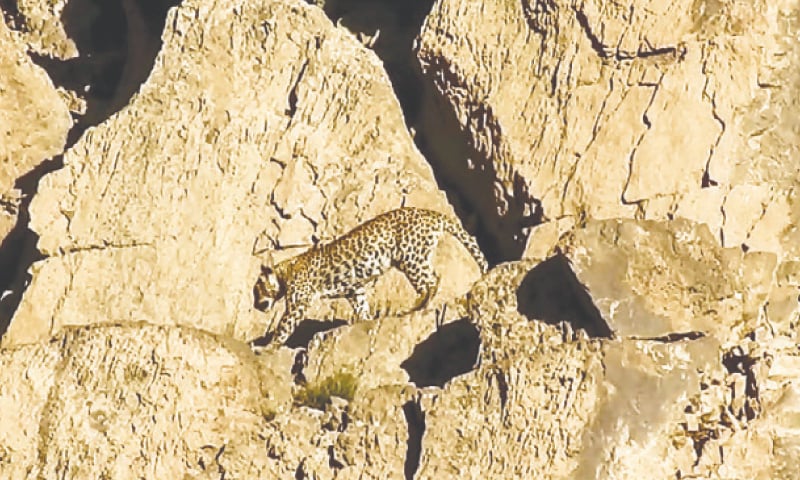

QUETTA: A pair of rare Persian leopards has been found in the Chiltan mountain range adjacent to the Hazarganji National Park, southwest of Quetta.
Officials of the Balochistan wildlife department first came to know about the presence of the pair six months ago. They launched a search for the Persian leopards, mostly found in Iran and Central Asia as well as some areas of Balochistan and Sindh.
Hectic efforts made by experts of the wildlife department bore fruit when they spotted the pair in a rugged mountainous area of Chiltan range and took pictures of the pair, said the Chief Conservator of Wildlife Department, Sharifuddin Baloch.
While releasing pictures of the leopard, the conservator said that the existence of this leopard species was in danger as it was rapidly becoming extinct.
Deputy Conservator of Forest and Wildlife Department Nazir Ahmed Kurd and some other officials took part in the search efforts.
Pictures and video showed the pair to be confident and they looked comfortable while living in the mountains.
Mr Kurd said the wildlife department would approach the International Union for Conservation of Nature (IUCN) and WWF for the protection of the leopards and seek their help and resources to provide them a natural atmosphere for increasing their population.
Adult leopards are solitary in the wild and pair only to mate.
“We equipped our staff with cameras and binoculars to film the pair and take photos,” Mr Baloch said.
Persian leopards are a panther sub-species native to Turkey, Iran, Afghanistan and the Caucasus.
They are extremely rare, however, and listed by the IUCN as endangered.
Published in Dawn, May 22nd, 2021