SC directs authorities to move Omar Sheikh from death cell to rest house


 28
28


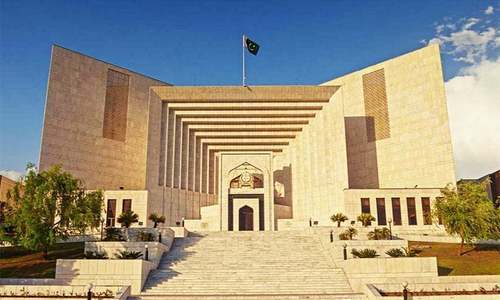
The Supreme Court on Tuesday directed authorities to move Ahmed Omar Saeed Sheikh, the prime accused in the 2002 killing of American journalist Daniel Pearl, from a death cell in the Karachi Central Prison to a government rest house within the next two to three days.
The apex court also directed authorities to ensure complete security of the rest house, and allowed Sheikh's family access to him from 8am to 5pm, while hearing a petition filed by the accused against his detention despite high court orders in this regard.
The accused, however, will not be given access to mobile and internet services while his family will be given accommodation and transport on the government's expense, according to the court's directives.
On Jan 28, by a majority of two to one, the apex court had upheld the high court's acquittal of Sheikh for Pearl's murder and ordered his release if he was not wanted in any other case.
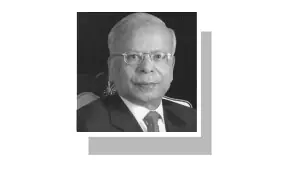
A day earlier, Attorney General (AG) Khalid Jawed Khan Attorney General Khalid Jawed Khan appeared before a three-judge SC bench, headed by Justice Umar Ata Bandial, to highlight that the high court had barred the federal government from issuing any preventive detention order when there was a mandatory requirement to issue a notice and hear the AG before issuing such orders.
The Supreme Court, however, preferred to maintain the status quo for a day instead of granting any stay against the SHC order in which the federal and provincial governments were directed not to issue any preventive detention order without prior permission of the high court.
The high court had also directed that all the accused — Sheikh, Fahad Nasim Ahmed, Syed Salman Saqib and Sheikh Muhammad Adil — be released from jail forthwith on the receipt of the order unless they were wanted in any other custody case.
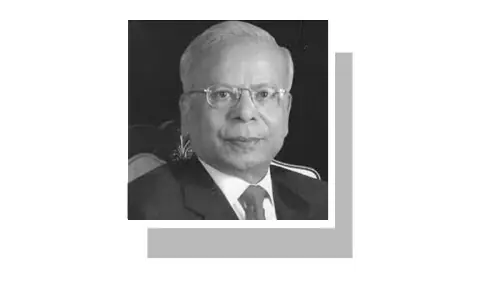
During today's hearing, the attorney general told the court that the country had been affected by terrorism during the past 20 years. "Tragedies such as those at the Army Public School and in Mach have not occurred anywhere else in the world. Omer Sheikh is not an accused but a terrorist mastermind."
Justice Umar Ata Bandial responded by asking the attorney general to prove Sheikh's terrorist links. "How does he relate to the incidents you have mentioned?" the judge asked.
The attorney general responded by saying that the state was of the opinion that the case against Sheikh was strong.
At this, Justice Muneeb Akhtar replied that until yesterday the attorney general's stance was that the SHC did not hear the federal government. "From your arguments it seems that you no longer have these objections," the judge remarked.
However, the Sindh advocate general replied that the federal government was not a party in the case heard by the high court.
"Did the Sindh government raise any objection in the high court regarding this?" asked Justice Akhtar. The Sindh advocate general replied that no objection was raised.
"The detention of the accused seems to be a provincial matter. The federal government has delegated its authority to the provinces. Therefore, it seems that only the Sindh advocate general needs to be given notice," Justice Akhtar said.
"The petitioner did not challenge a law which would warrant sending a notice to the attorney general," the judge remarked, adding that there were no grounds for a notice to be sent to the attorney general.
The attorney general replied that the court could not deprive the federal government of its powers. "There should also be proof before exercising powers," said Justice Shah, adding that the provincial government did not have proof to keep the accused detained.
When the attorney general replied that it was possible the state was in possession of such proof, the judge questioned why the material was not handed over to the provincial government.
"It seems that the attorney general has not read the reasons for the decision of the high court," said Justice Shah.
Justice Bandial also asked the federal government to present the evidence against the accused.
The attorney general informed the court that Sheikh held both Pakistani and British citizenship and had studied at the London Schools of Economics.
Justice Bandial remarked that Sheikh had been incarcerated for 18 years while the charges proven against him were for kidnapping. "Keeping one detained means 'no trial'," he said, adding that it would be wrong to accuse someone of being a terrorist without proof.