Wearing face mask made mandatory as second wave of Covid-19 sweeps across Pakistan



The National Command and Operation Centre (NCOC) on Wednesday, after continuous warnings of rising Covid-19 cases across the country, made it compulsory for all citizens to wear a face mask when stepping out of their homes.
The directive comes a day after Pakistan's active cases surpassed the 11,000 mark and Special Assistant to the Prime Minister (SAPM) on Health Dr Faisal Sultan announced that the second wave of the deadly virus had started in the country.
Today's NCOC meeting, presided over by Planning and Development Minister Asad Umar, decided that wearing a face mask will be mandatory in both government and private sector offices.
Later in a tweet, Umar said NCOC has approved the use of antigen testing in addition to the PCR tests being carried out.
"This is part of a strategy to increase the level of testing. The symptomatic cases will all still be administered PCR tests. The decision is in line with the guidelines issued by the World Health Organisation," he said.
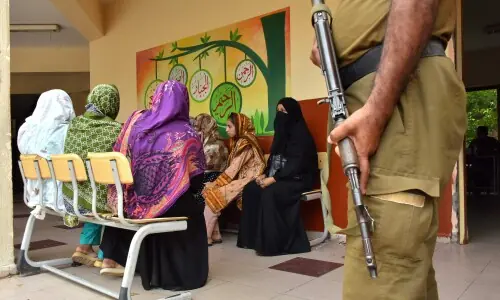
According to a statement by NCOC, all provinces have been asked to ensure that people wear face masks and adhere to standard operating procedures (SOPs), particularly in bazaars, shopping malls, public transport and restaurants.
NCOC released another statement later in the day, in which it listed non-pharmaceutical intervention (NPIs) that must be implemented in cities and districts where positivity rate exceeded two per cent. According to the statement, Karachi, Lahore, Islamabad, Rawalpindi, Multan, Hyderabad, Gilgit-Baltistan, Muzzafarabad, Mirpur, Peshawar and Quetta were among areas where more than 2pc tests came out positive.
The NPIs include:
strict enforcement of "compulsory mask wearing" rule in confined spaces including indoor venues, public transport, bus and train stations, markets and other crowded spots
implementation of broad-based smart lockdowns in areas identified as hotspots
closure of commercial activities by 10pm
closure of amusement and public parks by 6pm
Following the NCOC decision, the Islamabad district magistrate imposed Section 144 of the Criminal Procedure Code (CrPC) for two months to order the wearing of face masks/covers in public places in the capital. Anyone not wearing a mask in public could be arrested by police, Islamabad Deputy Commissioner Hamza Shafqaat said in a tweet.
'Battle against corona'
Addressing a doctors' convention organised by the Insaaf Doctors Forum in Lahore on Wednesday, Prime Minister Imran Khan also urged Pakistanis to follow health precautions in the next two months in view of a possible second wave of Covid-19. He said the country was still fighting a "big battle against corona".
"We fear a second wave could come and there are some indications that our cases are rising a little bit," he said, adding that he was worried more about the cities which suffer from pollution and smog in the winter.
He said the residents of Lahore, which experiences heavy smog in October-November, and cities like Karachi, Gujranwala, Faisalabad and Peshawar will have to be extra careful in the next two months so healthcare workers don't come under pressure.
The premier said he was proud of the way doctors, nurses and medical workers fought the first wave of the virus in mid-June, when hospitals were under increased pressure.
At present, 4,374 lockdowns have been imposed across 11 cities in the country; Quetta, Lahore, Rawalpindi, Multan, Peshawar, Islamabad, Hyderabad, Mirpur, Gilgit, Muzaffarabad and Karachi.
During a media briefing on Tuesday, SAPM Sultan said the number of Covid-19 cases was increasing every day. “A few weeks ago we were getting 400 to 500 cases per day, but now it has increased to 700 to 750 cases. Moreover, the mortality rate has also increased. Another ratio which is considered is percentage positivity — the number of positive cases in samples of 100 — that remained less than 2pc, but now it has reached close to 3pc,” he said.
Out of 1,884 ventilators allocated for Covid-19 patients, 93 were occupied on Tuesday. There was no patient on ventilators in Azad Kashmir, Gilgit-Baltistan and Balochistan.
Spokesperson for the Ministry of National Health Services Sajid Shah, while talking to Dawn, had said that if the number of Covid-19 cases continued to increase, the government would have no option but to take unpopular decisions due to which the country’s economy would be affected.
A similar warning was issued by NCOC last week that if people continued to flout health guidelines, it would have no choice but to order closure of services again.
Declaring the transport sector, markets, marriage halls, restaurants and public gatherings as high-risk areas, the centre had advised provinces to focus on them and take steps to prevent the spread of the virus.
Corona in Pakistan
The novel coronavirus was first detected in China in December last year, after which it spread to other countries. Pakistan closed its borders and took a number of steps to stop the spread. The first case of the virus was reported in Pakistan in the last week of February.
On March 13, a meeting of the National Security Committee, comprising top civil and military leadership, was held to discuss the crisis after it was declared a pandemic by the World Health Organisation.
Prime Minister Imran, who had chaired the meeting, directed the authorities to devise a comprehensive strategy to check the spread of the disease.
A lockdown was announced on March 16 and a number of industries, educational institutions, restaurants and marriage halls were closed.
The National Disaster Management Authority was involved to ensure availability of medical equipment and health-related supplies at the earliest.
After the construction industry was opened on Aug 7, the National Coordination Committee on Covid-19 lifted restrictions on tourism on Aug 8 and on restaurants and transport sector from Aug 10. It also gave a timetable for opening other sectors, including educational institutions and marriage halls.
On October 23, however, it was reported that the average positivity rate of Covid-19 cases rose 40pc over four days.
A jump was seen in hospital admissions and a spike in the number of daily deaths.
On Oct 27, SAPM Sultan formally announced that the second wave had started.
An analysis of the fatality rate last week showed that Pakistan’s figure stood at 2.06pc compared to the global 2.72pc and men accounted for 71pc of the total deaths. "Of these, 76pc are over the age of 50,” the NCOC had said.