Violence a threat to Afghan peace process, says US envoy



WASHINGTON: US special envoy Zalmay Khalilzad warned on Monday that “distressingly high” levels of violence in Afghanistan could derail ongoing peace talks between the Afghan government and the Taliban.
“Unfounded charges of violations and inflammatory rhetoric do not advance peace,” he said in a statement issued in Washington.
“Instead, we should pursue strict adherence to all articles of the US-Taliban agreement and US-Afghanistan joint declaration and not neglect the commitment to gradually reduce violence.”
Mr Khalilzad is the Trump administration’s special representative for Afghan peace and played a key role in arranging the US-Taliban deal and the joint declaration earlier this year. He is also encouraging talks between the Taliban and Afghan government that began in Qatar last month but became bogged down over Shariah interpretations.
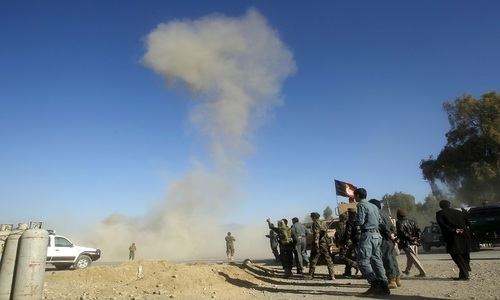
Ambassador Khalilzad’s comments followed renewed fighting in Helmand, a longtime Taliban stronghold in southern Afghanistan. On Friday, the Taliban agreed to halt their attacks if the US stopped its airstrikes in the area.
Mr Khalilzad reminded both sides that continued high levels of violence can threaten the peace process, the agreement and the core understanding that there was no military solution to the conflict.
“Violence today remains distressingly high despite the recent reaffirmation of the need for substantial reduction,” said the US envoy, noting that Taliban attacks in Helmand and their complaints of Afghan government operations and coalition strikes led to a recent meeting in Doha.
At the meeting, all sides agreed to decrease attacks and strikes and reduce violence and casualties, said Ambassador Khalilzad, pointing out that while violence in Helmand had decreased, violence overall in the country remained high. “Our expectation has been and remains that violence comes down and stays down,” he added.
The US envoy recalled that reducing violence was the focus of the US-Taliban agreement and it was further highlighted with the releases of prisoners and in the commitment all sides made to adhere to peace the deal.
Urging all sides to “adhere to the letter and spirit” of recent deals, Mr Khalilzad said that only this approach could “provide a path to minimising Afghan loss of life and protecting an historic opportunity for peace, which must not be missed.”
The Taliban said on Sunday that “all responsibility and consequences” of continuing US airstrikes on their positions “shall fall squarely on the shoulders of the American side.”
Published in Dawn, October 20th, 2020