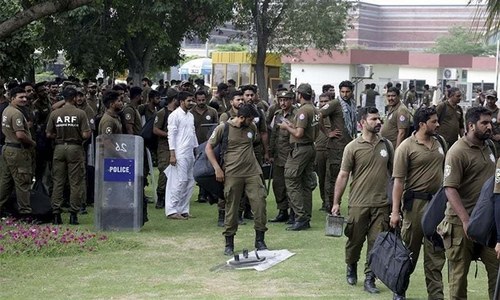
THE frequent and arbitrary transfer and posting of six IGPs and three CCPOs in the last two years at the behest of the Punjab government highlights the flagrant abuse of legitimate, democratic and legal authority. There are explicit statutory obligations in the Police Order (2002) that govern the appointment, tenure, transfer and posting of both offices, and there are corresponding decisions of the superior courts. The Punjab government, however, is unwilling to fetter its stranglehold over the police and continues to subvert the Police Order as well as court directions.
Prior to the Police Order, the Police Act (1861) governed Pakistan’s police forces. It was a colonial legacy, enacted after the War of Independence of 1857 to crush dissent and any support for self-government. Hence, it entrusted the superintendence of police to the political executive that could, inter alia, decide the tenure of the head of police or the IG and remove the officer without giving any reason. The police were thus reduced to a tool that served the political elite instead of providing essential services to ensure peace and the security of citizens.
The Police Order repealed and replaced the Police Act purportedly to depoliticise and democratise the police force by minimising illegitimate political influence and redefining its roles, functions and duties to transform it into a “professional, service-oriented”force, “accountable to the people”.
Whereas, ostensibly, the depoliticisation of the “ill-equipped, poorly trained, deeply politicised and chronically corrupt” police remains one of the top (forgotten) agendas in the manifesto of the ruling party, the latter has failed to replicate KP’s ‘successful’ police model nationally. In gross violation of the law, it continues to prematurely and arbitrarily post and transfer IGPs and CCPOs with impunity and has failed to constitute the public safety commissions at the district, provincial and national level as mandated by the Police Order.
Police have been reduced to serving the political elite.
The raison d’être of these commissions is devolution of control over police to depoliticise the force and to ensure it functions in a transparent, fair and democratic manner. However, in their absence, power remains concentrated in the political executive to the detriment of the public at large.
This was also stressed by former chief justice of the Lahore High Court Mansoor Ali Shah (Muhammad Razzaq case), who stated that the failure to constitute public safety commissions was against the public interest. He directed the province to establish provincial and the district commissions and to appoint the IGP strictly in accordance with the Police Order ensuring the security of his tenure.
While the Punjab government at the time appointed the IGP in compliance with the court order, contempt continued in the form of premature and arbitrary transfers and postings and the non-constitution of commissions.
Comparably, the Sindh High Court in the A.D. Khawaja removal case delineated the role of the Sindh government and the federal government as regards transfers and postings and directed them to reinstate the IGP to his position. The court stated that the IGP was entitled to the benefit of the term of his post and that removal would only be justified if there were “compelling reasons”within the parameters of the rule (Sindh Act, 2011).
The recent controversy over the transfer and posting of the current IGP and CCPO has reignited the debate on the unstructured discretion still exercised by the political executive in destabilising the police structure and obstructing meaningful reforms.
In this instance, too, as expected, all mandatory requirements laid down in the Police Order were flouted such as the security of the three-year tenure. Further, the current IGP and CCPO were illegally appointed through a unilateral order of the secretary of the Cabinet Division.
The Supreme Court in the Mustafa Impex case stated that power vested in the federal government, is vested in the cabinet as a collective identity constituting the prime minister and federal ministers. The same principle is applicable to the provincial government which constitutes the chief minister and provincial ministers.
Therefore, in the absence of prior approval of the respective cabinets, the actions of the chief minister or prime minister of their own volition, or anyone on their behalf, are ultra vires. Such unfettered discretion seeks to undo the constitutional structure that withholds the use of executive power beyond what is established by the law.
There is no doubt that political interference in police functions hinders the rule of law and can seriously undermine the enforcement of fundamental rights. Therefore, the arbitrary and premature transfer and posting of heads of police must not be trivialised as a political issue. It is a human rights issue that warrants our immediate attention.
The writer is a barrister.
Published in Dawn, September 25th, 2020