SBP unveils strategy for digital payments

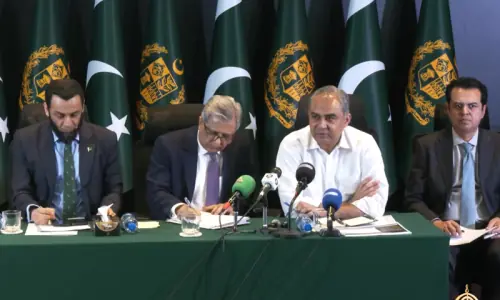
KARACHI: State Bank of Pakistan Governor Reza Baqir launched the National Payment Systems Strategy (NPSS) on Friday.
Speaking to a gathering, which included World Bank President David Robert Malpass, Baqir said “this strategy lays out a road map and action plan for Pakistan to have a modern and robust digital payments network.”
He continued that the key goal of this strategy would be to make access to financial services easier for people and help improve financial inclusion, particularly for women, along with greater documentation of the economy.
The event was attended by key stakeholders including regulators, government entities, banks, telcos, Electronic Money Institutions, Payment System Operators/Providers (PSO/PSPs) and other fintechs.
Baqir announced the issuing of the rules for digital onboarding of merchant, which will help increasing the touch points for digital payments in Pakistan. He also shared that SBP is developing a faster payment system that will simplify the requesting, receiving and sending of payments in the country.
Meanwhile, Malpass in his keynote address acknowledged the latest progress made towards unlocking Pakistan’s potential and called the development aptly timed with respect to the country’s stabilisation.
“By migrating to electronic means, the strategy intends to boost Pakistan’s GDP by seven per cent, create four million jobs, resulting in $263 billion in new deposits, representing a potential market of $36bn, all by 2025,” the newly published document notes.
It notes that the current digital infrastructure is severely lacking both from demand and supply sides, which won’t be changed at a mass level unless large recurrent streams like government payments are leveraged upon.
While the country has been on a transformational journey thanks to innovations like branchless banking, it still lags behind countries with similar economic dynamics. That the strategy attributes to the lack of infrastructure, such as an automated clearing house.
It highlights the role government payments, such as those for a benefits programme, can play in expanding the digital footprint given their magnitude. Further Pakistan Post was recognised as having high potential for payments modernisation.
There is also immense potential to other significant areas of collections and distributions such as tax and non-tax (fines and fees) or Benazir Income Support Programme and Employees Old Age Benefits Association, respectively.
To enable all of these, the plan recommends exploring the possibility of a shared government payments platform, across all agencies and levels, through which disbursement and collections could be made.
With regards to the legal framework, the document says that SBP’s current exclusive focus on card schemes, banks and regulated financial institutions concerning the subject of payments.
That mandate should further broadened to incorporate all payment systems, instruments and services, including electronic money.
The policy continues that SBP should classify all payment systems operating in the country as digital payment systems (DPSs), with each payment system and instrument being designated specifically.
This includes the payment activities of Pakistan Post, as it provides domestic and international remittances and collects money on behalf of billers, and taxes, fees and fines for the federal and provincial government.
Published in Dawn, November 2nd, 2019