0
0
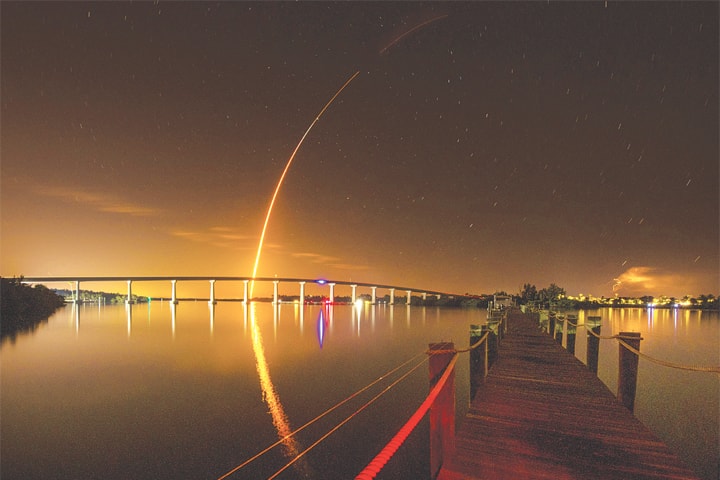
CAPE CANAVERAL: SpaceX celebrated the successful launch on Saturday of a new astronaut capsule on a week-long round trip to the International Space Station — a key step toward resuming manned space flights from US soil after an eight-year break.
This time around, the only occupant on board SpaceX’s Crew Dragon capsule was a dummy named Ripley, but NASA plans to put two astronauts aboard in July, although that date could be delayed.
The new capsule blasted off aboard the Falcon 9 rocket built by SpaceX — run by billionaire Elon Musk — at 2:49am from the Kennedy Space Centre at Cape Canaveral, Florida, lighting up the coastline.
The first and second stages separated without incident, placing Dragon in Earth’s orbit 11 minutes after take-off.
Every successful stage of the mission — whose planning suffered three-year delays — triggered cheers at the firm’s headquarters and at the Kennedy Space Centre.
“I’m a little emotionally exhausted, because that was super stressful but it worked, so far,” Musk told a late-night press conference an hour later.
“It’s been 17 years, we still haven’t launched anyone yet, but hopefully we will later this year.”
The next tricky step for the capsule will be docking at the ISS on Sunday at around 1100 GMT, with a return to Earth scheduled for next Friday.
It is to splash down in the Atlantic Ocean, and then return to Cape Canaveral.
The mission aims to test the vessel’s reliability and safety in real-life conditions.
Ripley — nicknamed in honour of the character played by Sigourney Weaver in the “Alien” movies — is fitted with monitors to test the forces that future astronauts will be subjected to on takeoff and when they return to the Earth’s atmosphere and then land in the Atlantic, braked by giant parachutes.
The mission’s successful start provided some immediate reassurance.
At the press conference, Musk asked the two NASA astronauts slated to fly in Dragon: “You guys think it’s a good vehicle?” They both nodded.
“Seeing a success like this, that really gives us a lot confidence in the future,” said one of them, Bob Behnken.
In another success, the rocket’s first stage returned to Earth, landing on a platform 500 kilometres off the Florida coast in the Atlantic. It marks the 35th such recovery by SpaceX.
“Today represents a new era in space flight,” said Jim Bridenstine, head of the US space agency who sees the launch as a step toward the privatisation of low Earth orbit.
“As a country, we’re looking forward to being one customer of many customers, in a robust commercial marketplace in low Earth orbit, so that we can drive down costs and increase access in ways that historically have not been possible,” he said.
After the shuttle programme was shut down in July 2011 following a 30-year run, NASA began outsourcing the logistics of its space missions.
It pays Russia to get its people up to the ISS orbiting research facility at a cost of $82 million per head for a round trip.
In 2014, the US space agency awarded contracts to SpaceX and Boeing for them to take over this task. But the programme has suffered delays as safety requirements are much more stringent for manned flights than for unmanned missions to deploy satellites.
Boeing also received a contract in 2014 to develop a space vessel, the Starliner. It will not be tested until April, in a mission similar to SpaceX’s.
NASA did not want to rely on just one vehicle, in case of accidents.
For SpaceX, sending an astronaut into orbit would be a culmination of years of hard work and high-risk investment.
In less than a decade, it has become a key partner for NASA, in addition to dominating the market for private satellite launches.
Its Falcon 9 rockets have resupplied the space station 15 times in seven years, though one of them blew up in 2015.
Published in Dawn, March 3rd, 2019