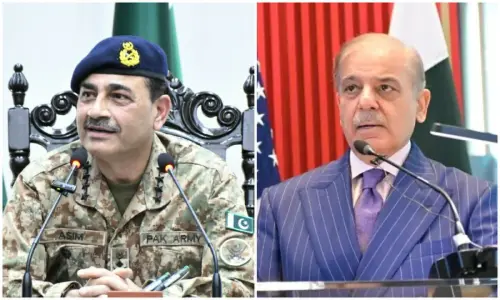
MISSING persons are a stain on the country, and for too long not enough has been done to address the matter. So it is welcome that President Arif Alvi has claimed that the prime minister, army chief and the judiciary are in discussion to address the matter of missing persons. On the day President Alvi made the claim, data from the commission of inquiry on enforced disappearances revealed that 318 new cases of alleged missing persons have been reported to the commission since August. That troubling number indicates that the problem of missing persons is an ongoing and severe issue and that elements within the state apparatus are continuing to abuse their powers and authority. The PTI’s interest in the matter of missing persons has been a positive surprise, with the party’s political alliance with the BNP-M in Balochistan seemingly driving the federal government to do more to resolve what has become an intractable issue.
The resolution of the missing persons issue is fundamentally linked to the establishment of the rule of law in the country and the state being held to account for unlawful actions against citizens. The long fight against militancy is Pakistan’s own war, and terrorism, militancy and violent extremism are very real problems. But the state must work in a lawful manner at all times. Counter-insurgency and counterterrorism campaigns are in very different stages than they were a decade or even a few years ago. Detention centres in Khyber Pakhtunkhwa have been formalised and given lawful protection. The Constitution has twice been distorted to create and extend the life of military courts for civilian terrorism suspects. While there can never be a justification for citizens to be disappeared in the name of national security or fighting militancy and terrorism, the present time is a particularly shocking moment for 318 individuals to have been reported missing to the inquiry commission in the span of just a few months. What is the need for the abhorrent practice?
The Islamabad High Court has helped point the state in the right direction with its historic decision on missing persons: accountability and direct responsibility for elements within the state allegedly involved in the practice of missing persons. The PTI government too has set a welcome precedent by appointing a vocal human rights minister who has already spoken repeatedly about the need to address the problem of missing persons. President Alvi has shown courage in speaking on an issue that is of concern in all units of the federation. But there is need for real progress to be demonstrated. One sign would be a decline in new complaints being logged. Another would be for a satisfactory resolution of more existing complaints. As human rights activists have suggested, missing persons complaints are often handled inappropriately. The state can and must do better; all citizens of the country deserve their full rights.
Published in Dawn, December 3rd, 2018