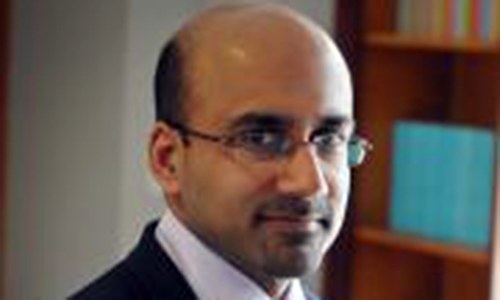
London-based economist Dr Imran Rasul has become the second member of government's Economic Advisory Council (EAC) to resign following the exclusion of US-based academic Dr Atif R. Mian, who was asked to step down from the body due to backlash over his Ahmadiyya faith.

"With a heavy heart, I have resigned from the EAC this morning," Dr Rasul, a professor of economics at University College, London, said in a tweet.
The economist said he "profoundly disagree[s]" with the circumstances in which Mian was asked to resign from the council.
Editorial: Atif Mian's removal has dealt another blow to Jinnah's vision of a tolerant & inclusive Pakistan
"Basing decisions on religious affiliation goes against my principles, or the values I am trying to teach my children."
In a series of tweets, Dr Rasul spoke in favour of Mian's appointment to the advisory council, saying "if there was one academic on the EAC that Pakistan needs, it was [Atif Mian]". He added that the formation of the EAC and the panel's composition offered a great opportunity to devise a better economic policy.
"Resolving the macro and fiscal mess the country is in will lay the bedrock for social protection, poverty alleviation policies and other economic reforms the country also needs," he reminded.
Wishing the government and the EAC luck in their future undertakings, the professor said he remains willing to offer "non-partisan, evidence-based advice" that can help improve economic policymaking in Pakistan.
Truth be told, if there was one academic on the EAC that Pakistan needs, it was @AtifRMian. Resolving the macro and fiscal mess the country is in will lay the bedrock for social protection, poverty alleviation policies and other economic reforms the country also needs. (3/5)
— Imran Rasul (@ImranRasul3) September 8, 2018
Dr Rasul said while Pakistan is full of talent, it "needs leaders willing to draw on all this talent, and that are willing to appeal to our better sides, for the common good and not sow division."
EAC's new composition
The first meeting of the recently reconstituted 18-member EAC was presided over by Prime Minister Imran Khan on Thursday. With the resignation of Dr Rasul, all three international economists of Pakistani origin on the council are no longer part of the advisory body.
Out of the remaining 15 members, seven belong to the government and eight are from the private sector.
The members of the council from the private sector are: Dr Farrukh lqbal, Dean and Director of the Institute of Business Administration; Dr Ashfaque Hassan Khan, Principal and Dean of School of Social Sciences and Humanities, National University of Sciences and Technology; Dr ljaz Nabi, Professor of Economics, Lahore University of Management Sciences; Dr Abid Qaiyum Suleri, Executive Director of Sustainable Development Policy Institute; Dr Asad Zaman, Vice Chancellor of Pakistan Institute of Development Economics; Dr Naved Hamid, Professor of Economics at Lahore School of Economics; Syed Salim Raza, former Governor of State Bank of Pakistan, and economist Sakib Sherani.
The official members of the council are: Minister for Finance, Revenue and Economic Affairs Asad Umer, Minister for Planning Development and Reforms Division Khusro Bakhtiar, Secretary of Finance Division Arif Ahmed Khan, Governor of State Bank of Pakistan (SBP) Tariq Bajwa, Adviser on Institutional Reforms Dr Ishrat Hussain, Adviser on Commerce Abdul Razaq Dawood and the deputy chairman of the Planning Commission.
Atif Mian's exclusion
Within three days of its rhetoric about the rights of minorities, the Pakistan Tehreek-i-Insaf (PTI) government bowed down to pressure from religious groups and asked renowned economist Atif Mian to step down from the EAC on Friday, only to lose another council member from the private sector hours later over the controversial move.
Explaining the circumstances that led to his resignation, Dr Mian said the government was facing tremendous pressure over his appointment from Muslim clerics and their followers. “For the sake of the stability of the Government of Pakistan, I have resigned from the Economic Advisory Council, as the Government was facing a lot of adverse pressure regarding my appointment from the Mullahs (Muslim clerics) and their supporters,” he tweeted.
Earlier on Tuesday, the government spokesman had strongly defended Dr Mian's appointment to the EAC on the grounds that Pakistan belongs to majority Muslims as well as non-Muslim minorities.
“What is wrong with the appointment of a professional economist as a member of the EAC?” said information minister Fawad Chaudhry, amidst a vicious online campaign targeting Dr Mian for his Ahmadiyya faith. “He is a member of the Economic Advisory Council and not the Council of Islamic Ideology,” he remarked.
Three days later the government apparently succumbed to the pressure generated by the call attention notice submitted in both houses of parliament against the appointment of a person belonging to the Ahmadi faith and a petition filed in the Islamabad High Court (IHC) challenging his appointment.
Explaining reasons for the government decision to withdraw the name, the information minister tweeted: “The government wants to move forward alongside scholars and all social groups, and it is inappropriate if a single nomination creates an otherwise impression.”
Hours after the announcement, another EAC member, Dr Asim Ijaz Khwaja, professor of International Finance and Development at the Harvard Kennedy School, announced his decision to resign from the advisory council.
Dr Khwaja tweeted: “Have resigned from EAC. Painful, deeply sad decision. Grateful for chance to aid analytical reasoning but not when such values [are] compromised. Personally as a Muslim I can’t justify this. May Allah forgive/guide me&us all. Ever ready to help. Pakistan Paindabad.”