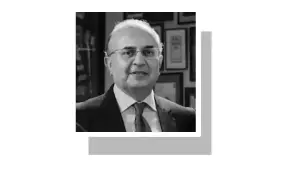
NEW YORK: Faced with an acute financial crisis left behind by the previous government, Pakistan’s incoming finance minister estimates the economy may need more than $12 billion infusion of loans within six weeks.
The minister designate Asad Umar, a former head of Pakistani conglomerate Engro Corporation said the nation’s financing gap is somewhere between $10bn to $12bn, though the new government would need a bit extra so it doesn’t “live on the edge,” he said in an interview with Bloomberg news.
Read: Imran Khan and the IMF: Pakistan's bailout dilemma
He also promised to make all Chinese agreements public after criticism of Beijing’s opaque Belt and Road loan terms.
“The decision needs to be taken in the next six weeks, the further you go forward the more difficult, the more expensive the options become,” Umar, 56, said in Islamabad.
Pakistan could turn to the International Monetary Fund, friendly countries and issue Diaspora bonds to bolster the nation’s depleting reserves, he said.
Pakistan’s deteriorating financial situation is a key challenge for new leader Imran Khan, the ex-cricket captain who is attempting to form a coalition government after winning the most seats in last week’s election. Many investors and analysts see a bailout from China or the IMF as inevitable.
Foreign-exchange reserves have slumped this year on the back of a widening current-account deficit, prompting the central bank to devalue the currency four times since December and hike interest rates. Moody’s Investors Service downgraded the nation’s outlook to negative last month, citing the nation’s worsening finances.
Mr Umar said Tehreek-i-Insaf hasn’t yet spoken to any potential lenders. “No formal work can be started until the government is formed,” he said.
If Pakistan asks the IMF for support, it won’t be the first time. The nation has gone through decades of debt blowouts and balance-of-payment imbalances and 12 IMF programmes since the late 1980s.
The amount of Chinese loans given to Pakistan over the last 13 months alone comes close to the IMF’s last bailout of $6.6bn. Those vast debts from Beijing have prompted worries from US Secretary of State Mike Pompeo, who said this week he would be watching to see if Khan’s new government uses IMF funds to pay off the opaque Chinese loans. Umar said he would bring more transparency to the more than $60bn Belt and Road infrastructure projects in Pakistan and hit back at Pompeo’s comments.
“One friendly advice to the Americans, we’ll worry about our Chinese debt, but I think they better handle their own Chinese debt first,” he said.
“We have a serious external debt problem, I’m not saying we don’t,” though “we don’t have a Chinese debt problem.”
With Pakistan’s finances under stress, Khan may struggle to implement his plans to create an “Islamic welfare state.”
The 65-year-old leader has been coy about how he will fund his expansionist plans, though he said in an interview last month that loans would be needed in the short term.
Reiterating comments made by his leader Imran Khan to Bloomberg in July, Umar said his party won’t attempt to privatise Pakistan’s bloated and loss-making state companies such as Pakistan International Airlines and Pakistan Steel Mills.
Umar said within the first 100 days of the new administration the state-owned firms will be shifted into a wealth fund – similar to Singapore’s Temasek Holdings Pvt Ltd – to remove them from political interference. The government will also have to take over some, if not all, of the national airline’s Rs367bn debt ($2.1bn) to start the carrier’s turnaround, he said.
Published in Dawn, August 4th, 2018