ISLAMABAD: The Human Rights Commission of Pakistan (HRCP) has predicted that the coming general elections will be the dirtiest, most micromanaged and most intensively participated polls in the country’s history.
Speaking at a news conference held a few hours after his meeting with the chief election commissioner (CEC) on Monday, HRCP spokesperson I.A. Rehman said that the commission had received complaints which were contrary to the spirit of elections.
Take a look: July 25 elections will be fairest in country’s history: PTI
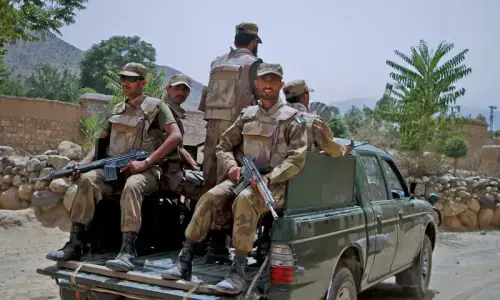
“We have serious doubts that elections will be free and fair. Before elections, efforts have been started to pressurise candidates to return tickets. Moreover, we have serious reservations about the use of military troops inside polling stations. So the issue was taken up with the CEC and he assured that officials will not go inside election booths,” he said.
Mr Rehman said that recently the Federally Administered Tribal Areas’ political agent had called a meeting of tribal elites on the general elections and told them what was in the interest of the country.
Spokesperson predicts July 25 polls will be the dirtiest, most micromanaged and most intensively participated in country’s history
“In 2013 some political parties were targeted and ‘favoured ones’ were not targeted by terrorists — the same is the situation again. Registration of cases under the Anti-Terrorism Act against political workers is condemnable,” he said.
Mr Rehman said that during the meeting the CEC listened to his questions and replied to some of them.
“He was told that what happened with Dawn newspaper, and what happened with The News till they developed an ‘understanding’ with the Inter-Services Public Relations. It was also informed that newspapers were reluctant to publish advertisements of some persons. The CEC said he was ready to take action but evidence should be given to him. When it was told that heads of proscribed organisations were working, the CEC said please let me know if any banned organisation is working,” he said.
Mr Rehman suggested that the Election Commission of Pakistan (ECP) look into the issue and take action in this regard. Answering questions, he said an environment had been created in which people were scared of sharing their affiliation with political parties. He said it was nothing but a symptom of downfall.
HRCP council member Advocate Hina Jilani said that a number of incidents of violence had taken place over the past few days. She said the ECP should use military to ensure peace during election campaigns.
“Forces which should have been eradicated still exist and they are striking. There is a section of political class which is more targeted. We are convinced that elections are conducted in an environment which will affect the results. Political engineering and media management are being done,” she alleged.
Ms Jilani said hate speeches were being delivered. One political party’s advertisement is trying to portray that a personality has connection with a neighbouring country.
“As a whole political engineering is being done, people are forced to quit political parties and we have credible accounts. The ECP is empowered to deal with such issues. Inclusion of military should be only for the security but it has been given more powers which have created doubts,” she added.
Marvi Sirmed, another HRCP council member, said that it was unfortunate that banned organisations were being allowed to take part in the elections and no one was ready to take the responsibility.
According to a statement shared during the press conference, the HRCP has serious reservations over the extraordinary powers accorded to security forces — ostensibly to ensure the integrity of the polls. That some 350,000 security personnel are to be deployed outside as well as inside polling stations, and that military functionaries have been assigned magistrate’s powers on the premises, has blurred the line between civilian and non-civilian responsibility for the electoral process.
The HRCP is deeply concerned that the political class is being selectively squeezed. This is apparent from reports that members of the Pakistan Muslim League-Nawaz (PML-N) are being pressurised to switch political loyalties, that candidates are being asked to return their tickets, and that electoral opposition to two mainstream parties — the PML-N in Punjab and the Pakistan Peoples Party in Sindh — is being ‘manufactured’ in strategic areas.
The HRCP is strongly concerned over the recent curbs on the print and broadcast media — specifically, the numerous instances in which journalists perceived as favouring the PML-N or PPP or deemed critical of the security establishment have been subject to censorship, intimidation, harassment and abduction.
The undeclared curbs on distribution in the case of Dawn and The News in cantonments, and earlier attempts to block the transmission of Geo TV are tantamount to denying people access to reports and analysis of electoral issues. Such pressures on the media serve to manipulate public opinion, forestall critical debate and leave powerful institutions unaccountable to the public.
Published in Dawn, July 17th, 2018