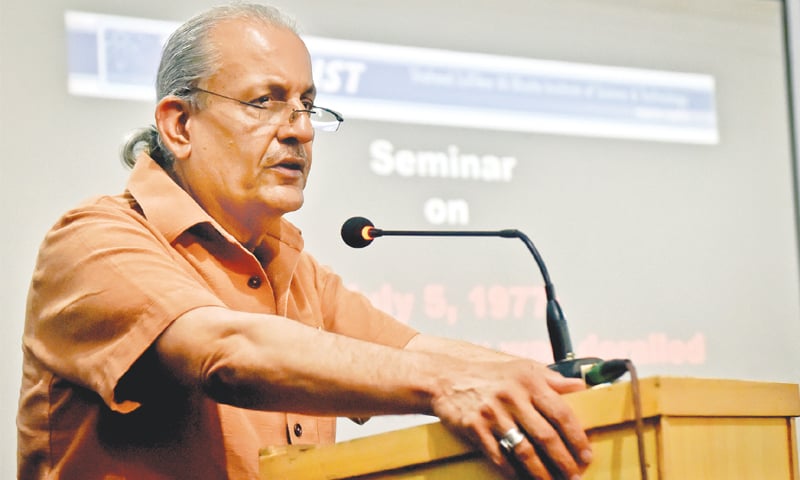

KARACHI: What happened exactly 41 years ago, on July 5, 1977, when Zulfikar Ali Bhutto’s government was overthrown by Gen Ziaul Haq was remembered and pondered upon at a seminar titled ‘When democracy was derailed in Pakistan’ at the Shaheed Zulfikar Ali Bhutto Institute of Science and Technology (Szabist) here on Thursday.
Looking back at how things have been over the years since July 5, 1977, politician and former chairman of Senate Mian Raza Rabbani said that during Ziaul Haq’s time the international situation was such that Islamist thought was used to deal with socialist thought. The word ‘freely’ used for minorities to go to their places of worship was deleted from our history. Of course, this was discovered later and today ‘freely’ is back in the 8th Amendment,” he said.
“But our civil and military bureaucracy still have pre-Partition minds. The ‘gora sahib’ has been replaced by the ‘kala sahib’, who also likes to oppress the people and keep the truth from them so that no one asks questions about the country’s resources and where they were going,” he said, adding that he did not see political stability on July 25 as “we have not learned from our past mistakes”.
Engineered elections have not helped us before, they will not help us in the future: Raza Rabbani
“When you bring a choon choon ka murabba in the National Assembly, well then what do you expect?” he said.
“It is sad. The first point of order in our constituent assembly was on the Bengali language. They were asking to let there be two languages, but we didn’t listen. For power we announced One Unit and spoke of parity. But what happened then? And what are we talking about now, to take back the political autonomy given to the provinces?” he said.
“The ones in power have their eye on the federal kitty. If it becomes less how will they feed off the government? Then they ask why their resources are going to the provinces.
“There have been other martial laws in Pakistan besides Ziaul Haq’s martial law, but it was his martial law that changed the basic structure of the state’s constitution. And today the constitutional order seems to be at war with itself because parliaments are the weakest links. This is a fact,” he said.
“It is in our interest now to let bygones be bygones. There is still time. There are still 20 days left before the elections. Let there be free and fair elections. Engineered elections have not helped us before, and they will not help us in the future,” he said.
Earlier, senior journalist Mazhar Abbas said that election now seemed like a lollypop to pacify the nation and to tell them that this much democracy and politics was enough. “Politics is a business now. But we never fought and stood up for this kind of a democracy where trade unions and student unions were throttled and still not revived as that would have given way to new politicians,” he said. “The seed sown on July 5, 1977 is now a big tree not providing shade for anyone.”
Political economist S. Akbar Zaidi said there was Ayub, Zia, Musharraf, etc, in Pakistan and always a war between democracy and dictatorship. “But it was only Ziaul Haq among them who used religion to move ahead his own agendas. And now we have women being treated harshly, minorities not being given their rights, which are a result of Zia’s Islamisation thanks to which sectarianism flourished, schools’ curricula changed. It is all Zia’s legacy,” he said.
“We were all Muslims, living in Pakistan, but it is odd how this country was turned into a different Islamic state in Zia’s time, how people here started practising their faith differently. Did Zia see a fault line which he needed to correct here? Is this now Jinnah’s Pakistan or Zia’s Pakistan? It is definitely not Jinnah’s Pakistan, which ceased to exist on July 5, 1977.”
Human rights activist Anis Haroon said that democracy was unstable in Pakistan even after 70 years of its existence. “And we have witnessed this instability all our life. Zia on July 5, 1977 threw us into the lap of extremism. There was Ayub, too, before Zia but Zia was a dictator who shook the foundations of this state and poured poison into our roots,” she said.
Published in Dawn, July 6th, 2018