WASHINGTON: Afghan National Security Adviser Mohammad Hanif Atmar has said that if Pakistan wants, it can end terrorism in Afghanistan by choking the routes that insurgents use for entering the war-ravaged country.
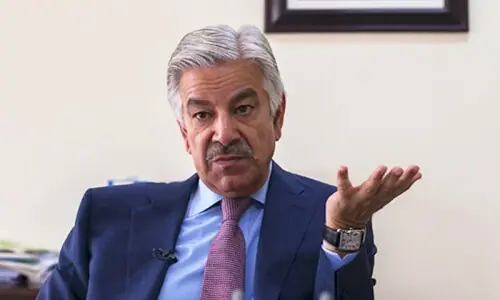
However, Defence Minister Khurram Dastgir rejected the Afghan claim, while pointing out that nearly half of Afghanistan was under the Taliban’s control and they did not need sanctuaries in Pakistan to continue their activities.
Both officials made these claims in interviews to the Voice of America this week, as the United States sent yet another official to Islamabad on Thursday for talks with Pakistani leaders.
Ambassador Alice Wells travelled from Afghanistan to Pakistan to “discuss our South Asia strategy and Pakistan’s stated commitment to eliminate all terrorist groups present in its country”, said the US State Department in a statement issued in Washington.
Khurram Dastgir tells Hanif Atmar 45pc of Afghanistan is out of Kabul government’s control
“There will be no foreign fighters without Taliban in Afghanistan and there will be no Taliban insurgency without sanctuaries in Pakistan,” the Afghan national security adviser told VOA. “So, we need to see some action.”
But, Mr Dastgir rejected his argument. “You don’t control 45 per cent of Afghanistan and don’t know what is going on there, who is there, who is moving in and out of that safe haven, but you keep blaming us,” he said.
In a story based on the two interviews, VOA noted that US President Donald Trump’s South Asia strategy has not changed Afghanistan’s fundamental challenge, the presence of armed and motivated militants who show no sign of giving up the fight.
“Efforts to bolster Afghanistan’s armed forces, along with an increased use of American air power, seem to be doing little to change the country’s reputation as a magnet for foreign fighters and jihadists,” it commented.
Mr Atmar strengthened this argument by claiming that fresh jihadists were now coming to Afghanistan from places like Iraq and Syria via routes that lead through Pakistan. “There has been a growth in the number of the foreign fighters in the country,” he said. “We’re talking about hundreds of them coming from the Middle East through Pakistan, and other regional groups.”
VOA reported that these fresh recruits were not just joining the Afghan Taliban movement but they were also going over to other terror groups, such as Al Qaeda, the Islamic Movement of Uzbekistan, the Eastern Turkistan Islamic Movement, Lashkar-e-Taiba and Jaish-i-Mohammad.
Mr Atmar claimed that the influx was changing the dynamic of terrorism in Afghanistan, as these groups were forging new ties with each other and the Taliban, allowing them to collectively benefit from this development.
“They have a symbiotic relationship with the Taliban, and the Haqqani and the drug networks,” he said. “The foreign fighters need Taliban as their local host and protector. And the Taliban need them for their knowledge, their expertise and their resources.” Mr Atmar said that only Pakistan could undo this new arrangement by cracking down on the Taliban who were still operating from the Federally Administered Tribal Areas.
Mr Dastgir, however, said Pakistan had eliminated all terrorist sanctuaries, forcing the Taliban to move to Afghanistan where they control enough territory to hide, plan and execute their attacks.
Published in Dawn, March 30th, 2018