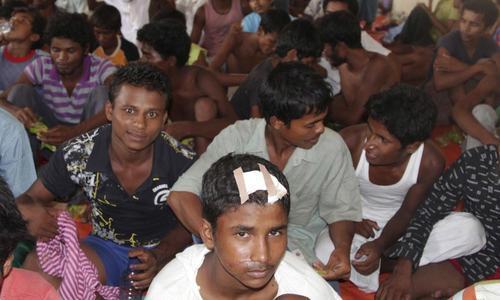
Myanmar forces continue 'ethnic cleansing' of Rohingya, says UN


Myanmar is continuing its “ethnic cleansing” of the Rohingya with a “campaign of terror and forced starvation” in Rakhine state, a United Nations (UN) human rights envoy said on Tuesday, six months after a military crackdown sparked a mass exodus of the Muslim minority.
Some 700,000 Rohingya have fled over the border to Bangladesh since violence erupted in August, taking with them horrifying testimony of murder, rape and arson by soldiers and vigilante mobs.
While the majority of those refugees fled Myanmar last year, Rohingya continue to stream across the border by the hundreds every week.
“The ethnic cleansing of Rohingya from Myanmar continues. I don't think we can draw any other conclusion from what I have seen and heard in Cox's Bazar,” UN Assistant Secretary-General for Human Rights Andrew Gilmour said after speaking to newly-arrived Rohingya in Bangladesh's crowded refugee camps.
“The nature of the violence has changed from the frenzied blood-letting and mass rape of last year to a lower intensity campaign of terror and forced starvation that seems to be designed to drive the remaining Rohingya from their homes and into Bangladesh,” he said in a statement, adding that new arrivals are travelling from interior Rakhine towns further from the border.
Repatriation 'inconceivable'
His statement also said it was “inconceivable” that any Rohingya would be able to return to Myanmar in the near future, despite Myanmar's pledges to start taking back some refugees.
“The government of Myanmar is busy telling the world that it is ready to receive Rohingya returnees, while at the same time its forces are continuing to drive them into Bangladesh,” Gilmour said.
“Safe, dignified and sustainable returns are of course impossible under current conditions.”
Myanmar's military has largely closed off northern Rakhine state to journalists, diplomats and most aid organisations outside of brief chaperoned trips.
It has justified the crackdown as an effort to root out Rohingya militants who attacked border police posts in August, killing about a dozen people.
But the UN, rights groups and many Western powers have accused the army of using the counterinsurgency as a pretext to expel a minority that has faced brutal discrimination for decades.
Doctors Without Borders (MSF) has estimated that at least 6,700 Rohingya were killed in the first month of the crackdown alone.
Hundreds of Rohingya villages were torched, and recent satellite imagery showed at least 55 villages have since been completely bulldozed, removing all traces of buildings, wells and vegetation.
Myanmar's military has denied committing any abuses outside one incident in the Rakhine village of Inn Din, where it said security forces assisted with the killing of 10 unarmed Rohingya.
Rights groups say that is the tip of the iceberg from a force with a grim history of abuses around the country and open hostility towards the Rohingya.
In a Facebook post on Tuesday, deputy army chief Soe Win reiterated the military's stance that the “Rohingya” are not a genuine ethnic group in Myanmar, a view shared by many in the Buddhist majority, where there is broad support for the army campaign.
Myanmar's civilian government, led by former democracy activist Aung San Suu Kyi, lacks control over the military but has been battered by rights groups for failing to speak in the Rohingya's defence or tamp surging Islamophobia.