IN a country where the chroniclers of history are too often either silenced or killed, the press in Balochistan continues to suffer the worse kinds of violence at the hands of state and non-state actors.
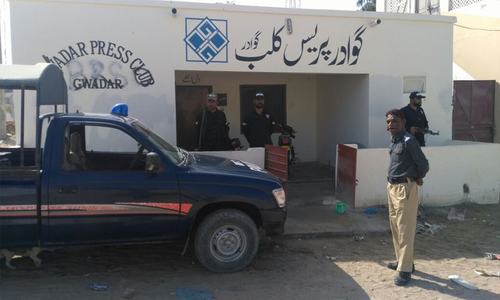
Last October, banned separatist groups — the Balochistan Liberation Front and the United Balochistan Army — threatened reprisals against newspapers in the province if they refused to publish their points of view, forcibly shutting down 24 press clubs and warning hawkers and distributors against selling newspapers.
Among the affected dailies were Azadi, Tawar, Intekhab, Bolan, Jasarat, Jang and Dawn. One can gauge the gravity of the situation from the fact that even hawkers and distributors stopped newspaper circulation in Baloch-majority districts, including Pasni, Turbat and Gwadar. Three months on, the situation remains unchanged.
Not too long ago it seemed that the pervasive information blackout in Balochistan could get no worse.
Read: Journalists in danger
However, what has been transpiring since last October is beyond what has been seen before.
The actions of the insurgents are condemnable: these same groups have no qualms in reaching out to international organisations for redressal of what they describe as the violation of their rights, but they continue to violate the rights of the Baloch to access information.
However, the state also bears some responsibility.
It too contributes to the repression of press freedom when it demands that journalists dilute their narrative or present the state’s version and give zero coverage to statements by militant groups, even when they claim responsibility for acts of violence. The resultant one-sided narrative, filled with obvious gaps in information, makes the peril multi-dimensional.
Journalists constantly walk on a razor’s edge, not knowing which quarter will take umbrage to their words — or lack of them, as the case may be. Often it is not the threats that define editorial policy but the very fear of such threats. Reporters must navigate a complex map of political players, including insurgent organisations, feuding tribes, sectarian groups, the FC and the security establishment.
In the case of dailies like Intekhab, ignoring the separatists’ side of the story is virtually impossible when the newspaper’s circulation is concentrated in districts where certain insurgent groups hold sway. Caught in this crossfire of opposing groups and agendas, the press in Balochistan is slowly but surely being suffocated.
Journalists must be allowed to do their duty without fear, to document all sides of a story, whatever the story.
Published in Dawn, January 8th, 2018