Picking up the pieces after a devastating shock to the system is not easy.
Pakistan is not the country it was until mere days ago. Yet, failure is not an option and it is time to ask searing questions.
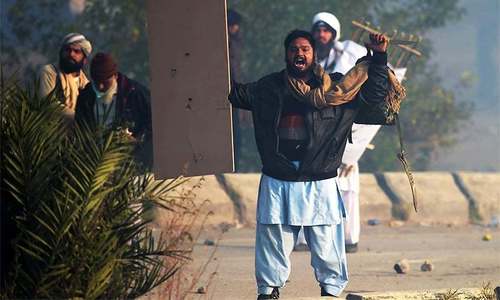
Has extremism truly gone mainstream? Or was capitulation by each and every institution of the state to a violent mob a last-gasp attempt at salvaging a modicum of stability in order to allow the state an opportunity to regain its composure before it can press ahead with its counter-extremism project?
Surely, decisions made in desperate, fearful moments cannot mean that for all time and for all intents and purposes the country has surrendered to extremism. Pakistan has had to contend with several such inflection points in its recent history.
The decisions made in the aftermath of 9/11 and the US-led war in Afghanistan; the events leading up to and after the Lal Masjid operation; the assassination of Benazir Bhutto; the military operation in Swat; the killing of Osama bin Laden in Abbottabad by US special forces; Operation Zarb-i-Azb in North Waziristan Agency; the Army Public School attack in Peshawar — each of those, and several other episodes have underlined both the fragility and resilience of this country.
What ought to be clear is that business as usual is absolutely no longer an option. The National Action Plan was Pakistan’s halting, uncertain attempt at devising a counter-extremism strategy, but it has gone nowhere. While there may have been several good ideas in NAP, none of them have been implemented to any degree that any sensible or rational analysis can deem satisfactory.
The significant strides made in the fight against anti-Pakistan militants who have taken up arms against the state and society have masked the broader failures in the fight against extremism.
There is simply no measure, no analysis and no assessment that can suggest that Pakistan is a country less threatened by extremism of any and every stripe than it was threatened by a decade ago. More desperately, there is a real sense that the state’s capacity to even understand the scale and scope of the problem has been undermined by its head-in-the-sand approach to extremist challenges.
If there is to be a solution — and it is not clear that there is an obvious solution — it may have to start with a simple premise: no more, no longer and never again. A zero-tolerance approach to bigots, zealots and mobs.
This country has the greatest of men, the most remarkable of leaders in the 20th century, as its founding father. Mohammad Ali Jinnah, the best of all statesmen, who knew not hate or bigotry or violence, is the reason this country exists. To his ideals we must return, to his vision we must re-commit ourselves.
Acknowledge extremism; defeat extremism; and let Jinnah’s Pakistan prevail.
Published in Dawn, November 29th, 2017