Oil transporters' strike: Talks fail as protesters refuse to budge from demands



The nationwide oil transporters' strike seemed headed towards developing into a crisis after a meeting on Tuesday between state officials and the All Pakistan Oil Tankers Association (APOTA), an umbrella organisation for the oil transporters, fell through.
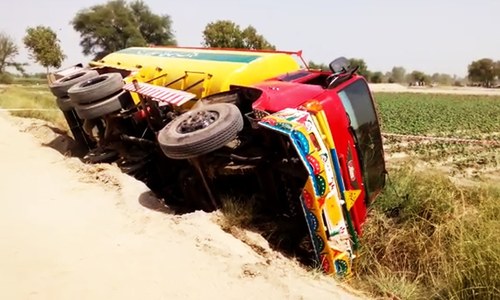
On July 24, APOTA had announced a countrywide strike to protest against the revised safety regulations for oil tankers introduced by the Oil and Gas Regulatory Authority (Ogra) in the wake of the Ahmedpur Sharqia incident, which had resulted in the death of 218 individuals.
The supply of petroleum products across the country has been affected by the strike, as the movement of nearly 23,000 oil tankers in the country remains halted.
In the Tuesday meeting, chaired by the secretary petroleum, the OTOA Chairman, Mir Muhammad Shahwani, put forward the following demands:
- The National Logistics Cell be abolished.
- Lorries be allowed to pass through the Kohat tunnel.
- Lorries be the only means of oil transportation to Peshawar.
- The current regulations system be continued and stricter laws not be implemented.
- The tariff for lorries be increased.
The reason cited for the failure of the negotiations was the refusal of the Oil Tankers Owners Association (OTOA) to budge from these demands and its insistence on continuing the protest till they were met.
The Ogra spokesperson, Imran Ghaznavi, rejected the demands saying that the authority will not be backed into a corner through "blackmail". He also accused oil marketing companies of backing the strike behind the scenes.
"The tankers' association is not licenced under Ogra; rather it is the oil marketers that are licenced by Ogra and they are now trying to evade the law through this strike," Ghaznavi said.
"The oil marketing companies have not been following Ogra's safety regulations," Ghaznavi added, stating that multiple letters sent to the companies by Ogra in this regard had yielded no response.
"These companies want to play with people's lives, but Ogra will ensure that this does not happen," he said.
Ghanznavi clarified that the government wants to resolve the matter but will only do so through civilised discussions. "Threats will not work," he warned.
"We are ready to hold a dialogue with the marketing companies and will try and hold a discussion with them soon."
"The secretary petroleum also wants to resolve the matter, but he has stated that legal action can be sought against oil marketing companies in case of continued non-compliance," Ghaznavi said.
The strike was announced days after Ogra fined Shell Pakistan Limited for failing to meet safety benchmarks and held it responsible for the Ahmedpur Sharqia incident.
Ogra had hired the services of two separate third-party inspection companies to ascertain whether Shell had complied with the 2009 Ogra technical standards for the transportation of petrol and to identify the reasons for the tragic accident in Ahmedpur.
Sources said that the ill-fated tanker did not even meet safety and transportation standards of the company itself, let alone Ogra’s 2009 technical standards.
When issuing the fine, the regulator had also estimated that around 85 per cent of oil tankers do not comply with the prescribed standards.
The oil industry, fearing reprisals, has been lobbying against any punitive action.
The industry is pushing for a grace period of up to two years to allow tanker lorries and oil marketing companies to comply with regulatory standards and is sending out signals suggesting that extreme steps like a ban on non-compliant tankers would lead to product dry-outs.
A strike by oil tanker owners earlier this year had caused a great deal of public inconvenience, especially in Karachi, where long queues of motorists and bikers were seen outside many petrol stations.