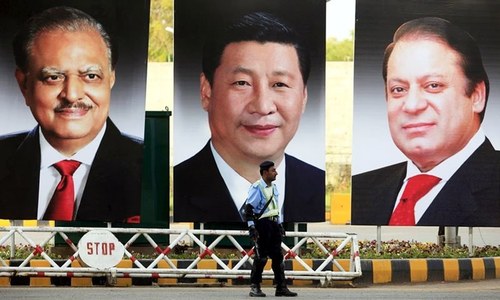
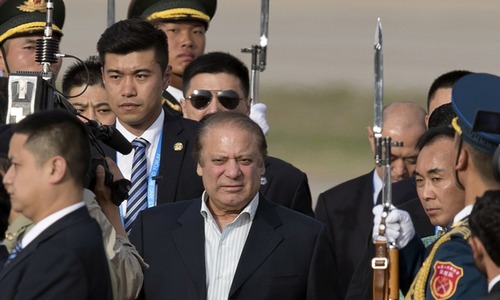
CHINA recently hosted 29 heads of state and government at the Belt and Road Forum, reinforcing the country’s claim to leadership of an emerging geopolitical and economic world order. The summit conference that also attracted representatives of more than 40 other countries and multilateral financial agencies was the clearest expression yet of China breaking out of its old foreign policy mould that had restrained it from attempting a global role.
China’s multibillion-dollar One Belt, One Road (OBOR) infrastructure development project linking the old Silk Road with Europe, is a manifestation of China’s growing geopolitical ambitions. A brainchild of President Xi Jinping, perhaps, the most powerful Chinese leader after Mao Zedong, OBOR has now been under development for four years, spanning 68 countries and accounting for up to 40 per cent of global GDP.
President Xi’s ambition of propelling China to centre stage of the global power game represents a sharp departure from the approach of previous Chinese leaders who strictly adhered to Deng Xiaoping’s tenet to “hide our capabilities and bide our time, never try to take the lead”. Thus over the past two decades, China has avoided being drawn into global conflicts and has completely focused its energies on development that helped it to become an economic superpower.
China’s push to take the world leadership has come at a time when a strong anti-globalisation wave is sweeping the Western world that is showing a growing tendency of returning to more protectionist regimes. The United States under the Trump administration with its inward-looking approach has virtually abandoned the mantle of globalisation thus ceding greater space to Beijing’s assertion.
It is evident that OBOR is not just about infrastructure development.
It is not surprising that the OBOR initiative is being embraced by a wide range of countries from Asia and Africa to Europe and even South America, notwithstanding some serious concerns about the cost and benefits of the enormously ambitious project. Surely fewer European countries showed up at the Beijing summit because of their reservations over China’s reluctance to open doors to foreign companies.
While addressing the forum, President Xi tried to alleviate concerns about China’s dominance, inviting other countries to take part in the project. China is spending roughly $150bn a year in the 68 countries that have so far signed on to the plan. According to Chinese government figures, around $1 trillion have already been invested in OBOR, with several more trillions due to be invested over the next decade. This way Beijing hopes to find a more profitable avenue for the country’s vast foreign exchange reserves, mostly invested in low-interest-bearing US government securities.
It is evident that OBOR is not just about infrastructure development; one of the major objectives of the initiative is to turn Eurasia into an economic and trading centre, breaking the domination of the American-led transatlantic regime. It is also a manifestation of the changing geopolitics and the realignment of forces, reflecting a move to shift the centre of gravity of trade to the East and establish China’s predominance in global politics.
Indeed, Russia has lent active support to the Chinese initiative indicating a growing strategic partnership between the two countries. Moscow’s major interest is to consolidate its primacy in Central Asia through regional security and a trade bloc.
However, it is willing to accommodate China’s economic and geopolitical interests more than ever because of Western sanctions following the Ukraine crisis. Since 2014, the two countries have reached several high-profile multibillion-dollar economic and trade deals signalling their close, evolving economic ties. Unsurprisingly, Russian President Vladimir Putin used the forum to lash out at the US and other Western countries over their increasingly protectionist policies.
Surely China considers the China-Pakistan Economic Corridor (CPEC) a “flagship project” in the whole scheme of OBOR. This multibillion-dollar investment programme has added a new dimension to the friendship between Pakistan and China. From purely strategic and security cooperation spanning more than five decades, the relationship has now evolved into a dynamic economic and commercial partnership.
This growing bilateral cooperation comes at a time when China’s rising geopolitical ambition also underscores its concerns about Pakistan’s security and its fledgling economy. Given its geostrategic position, Pakistan has the potential to serve as a nexus for the two routes — the continental Eurasian Silk Road Economic Belt and a Southeast Asian Maritime Silk Road
Although Beijing downplays geostrategic motivations, CPEC represents an international extension of China’s effort to deliver security through economic development. Notwithstanding their growing strategic cooperation, terrorist sanctuaries in Pakistan have remained a major source of worry for the Chinese government. China’s security concerns, especially those that arise from its restive region of Xinjiang, and the Islamist militancy threatening Pakistan’s stability have also been a strong factor in Beijing’s new approach to achieving security through economic development.
This growing Pakistan-China strategic alliance has also exposed the regional geopolitical fault lines. Predictably, India boycotted the Beijing forum citing serious reservations about the project, particularly regarding China-funded development in Gilgit-Baltistan that is linked to the Kashmir dispute. Yet another excuse given by the Indian authorities was that a trans-regional project of this magnitude required wider consultation.
Explore: Is India trying to convince the world China’s OBOR plan is secretly colonial?
Despite their geopolitical rivalry and long-standing border dispute, trade between India and China has grown significantly crossing $100bn. But there have been some visible signs of tension between the two most populous nations in the past few years with the strengthening of ties between Washington and New Delhi. India has openly sided with the US and Japan against China over the South China Sea issue.
Indeed, the success of the summit has provoked a strong reaction from Delhi. So much so that some leading commentators have called for tougher action to obstruct the OBOR project. “Far from this, CPEC (the life and soul of OBOR) threatens India’s territorial integrity in a manner unseen since 1962,” Samir Saran, a leading Indian commentator wrote in an op-ed piece.
Notwithstanding the scepticism, OBOR is a new geo-economic reality representing an emerging world order. The process cannot be reversed.
The writer is an author and journalist.
Twitter: @hidhussain
Published in Dawn, May 17th, 2017