ISLAMABAD: A major parliamentary push is being planned to compel Islamabad and Tehran to overcome the internal resistance in their countries to greater bilateral economic engagement and revitalising of relations.
This was disclosed by Chairman of the National Assembly’s Foreign Affairs Committee Awais Leghari. He recently visited Iran to attend a conference on whose sidelines he held discussions with Speaker of Iranian Majlis Ali Larijani, Chairman of the Committee for Foreign Policy and National Security of the Islamic Consultative Assembly of Iran Allaudin Boroujerdi and other officials.
Mr Leghari was particularly encouraged by Iranian officials accepting his request for lifting a ban on import of kinnows from Pakistan after six years. Although the restriction has been relaxed for two months, Mr Leghari hopes to get it permanently removed.
“A delegation of the National Assembly’s Foreign Affairs Committee will visit Iran in May for talks with the Committee for Foreign Policy and National Security of the Islamic Consultative Assembly,” he said, adding that the discussions would be aimed at forging a joint strategy of the two committees for pushing their respective governments to develop economic ties. He said the intention was not only to develop recommendations but also to pursue their implementation.
The two parliamentary committees would then jointly visit Chabahar and Gwadar ports to emphasise that the two were not each other’s competitors.
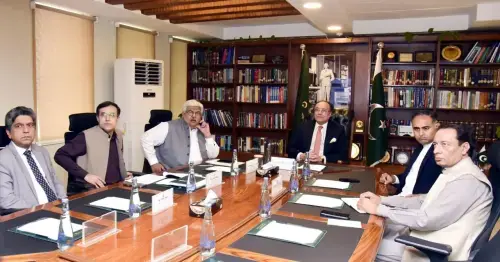
Mr Leghari, who has convened a meeting of the NA Foreign Affairs Committee on Friday for discussion on Pak-Iran ties, said he had always been encouraged by the government to work for enhancing bilateral relationship with Tehran.
Talking about the mood in Iran, Mr Leghari said he felt a great appetite there for expanding economic ties. He, however, admitted that there were impediments to improvement in relations on both sides. About the factors that contributed to widening of the gulf between the two countries, he believed that it happened because both remained at the opposite ends of regional and global alignments for long. “Things will start moving the day both sides sit down to honestly and sincerely work for betterment of ties.”
Both sides, he observed, were now feeling “internal pressures” to engage in a big way for mutual benefit. “More pressure would have to be exerted from within the economies and people and media.”
Mr Leghari was of the view that Iran-Pakistan gas pipeline was one project whose implementation could change the complexion of the relationship. He said the project was being delayed not just because of paucity of funds, but there were other issues involved in it. Those issues, he however maintained, were not irresolvable.
Similarly, he said the agreement on border markets was not being implemented. The two countries had a few years ago agreed on setting up three border markets, which was renewed at a meeting of the border committee this month. “Establishment of border markets would improve the trade environment,” he hoped.
Iran, he said, had unfairly been blocking Pakistani agricultural projects probably for using it as leverage. Moreover, absence of banking arrangements was a major factor inhibiting trade.
Tourism, he believed, was one other area which had a lot of scope for cooperation.
Notwithstanding these obstacles, Mr Leghari said, he was convinced that both countries were on the verge of establishing strong economic relations. Moreover, he said he was hopeful that Iran would at some stage get connected with the western route of the China-Pakistan Economic Corridor.
Published in Dawn, March 9th, 2017