When I walked in through the emergency gate of Islamabad’s largest private hospital, I started feeling smaller. On the one hand, I was looking around for information on how to get a vaccination; on the other, I was battling an immediate onslaught of stares.
This shrinking of my emotional size almost felt physical. I asked around about where I should go, carefully avoiding the disapproval in people’s eyes. There was disgust, and perhaps even hate.
I was wearing dress pants, and an airy orange blouse that flowed below my waist. In my discomfort, I just took it all in — as one might do in the case of an attack, unless they have nerves of steel.
My panic worsened when I was informed where the nearest ATM was. To get there, I would have to pass by a mosque.
During the four minutes I walked, men whistled and winked at me; a stranger told me to cover my head; another asked if I had run out of cloth; and one brave soul informed said I was 'a great masterpiece of God’s creation'.
Take a look: In conversation with my Dupatta
The walk back was no different. By the end, I felt like a tiny creature huddling inside the hospital’s large expanse.
Most women in Pakistan can attest to having a similar experience in their life — ranging from verbal harassment, to groping, to sexual violence. All of these fall under the category of assault, and all are the aggressor’s fault. But, that is not what women are told.
We are told that the responsibility lies on our shoulders — or rather, on our dupattas.
It takes us a while to learn that that is not the case.
The day I was groped at a marketplace in Karachi, while draped in enough cloth for a Bedouin tent, was the day I finally told my 17-year-old self: it’s not me.
The same day, an old man clonked my head with his walking stick, because my dupatta was on my shoulders, and not my head. That day I also realised: it is them.
Explore: Public misogyny: Chronicles of a boy on Karachi's streets
By them, I do not mean just men. Often, the greatest moral policing is directed from one woman to another. Just this week, one such older woman was found harassing a young woman outside Karachi’s Agha’s supermarket.
The older woman chastised the younger one for dressing up in an ‘unacceptable’ manner. She then questioned the girl’s faith, and harassed her until the cops were summoned. The intent of her tone and words was to make the young girl feel inferior, unworthy, and ultimately — invisible.

There is a pattern of women taking up the role often played by men: of gate-keeping chastity.
But while men do it by catcalling and abusing, women do it by shaming. We criticise and condemn another woman’s choice of clothes, her appearance in public spaces, and her choice of company.
Many find themselves horrified at the prospect of other women loitering around in plain sight without male supervision.
These women are essentially channeling internalised misogyny. Despite years of grueling care-giving, their labour is not given the same worth as a man’s, and they realise they have no real status.
In reaction, defensiveness becomes a coping mechanism for them, and any woman who makes different choices in her life is seen as threatening.
These women who have seen the world work in favour of men start mimicking masculine ideas of control and power in order to be taken seriously, because that is what they know. Having had their own movement and behaviour prescribed for them by society — all in the notion of protecting honour — they now do the same to other women.
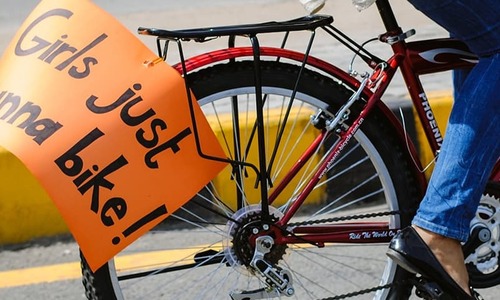
Read next: What is it about a girl cycling that says 'come harass me'?
One cannot blame culture or religiosity. In its absence, people will make up another ideology. The issue is that of control and its oppressive hold, especially on young (read: fertile) women.
Unfortunately, this control is exercised on women in public spaces in a way it is never exercised on men.
When we are alone, as I was, we are treated as public property anyone can comment on or touch. When we dare to loiter, as I did outside the mosque, we crash into the mighty monstrosity of control disguised as protection. For many, even going outside for groceries sometimes feel like an act of war.
We loiter because we have a claim to public spaces just as men do. We know that’s where the city life is, where the opportunity is. Where the freedom to walk, move and breathe is.
More importantly, women are the key to a country’s economic development. We will never move forward if there is an aversion to seeing women publicly.
And by seeing us, I mean seeing us on our terms — burqa or not, veiled or unveiled, camisole or shalwar kameez. Our clothes only reflect our lived identity, not someone else’s.
As we fight for greater visibility in the country, women especially, will have to make space for each other. It’s a battle that is perhaps more crucial than any other battle for gender — because it is linked to all of them.