0
0
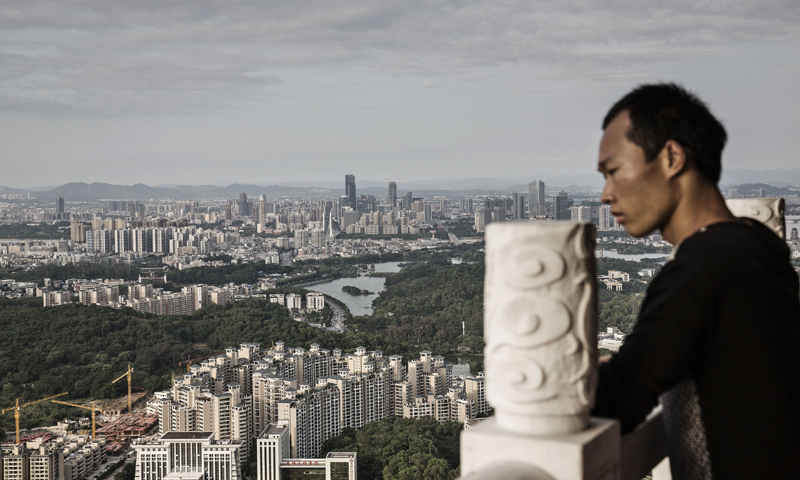
It’s quiet these days on a Sunday afternoon in the streets of Dongguan, where almost every block outside the center is a factory or housing for workers. A red banner advertising for staff above one plant says it has enough orders to keep production lines busy for a year. Locals say the sign has been there at least two years and it’s no longer true.
Only a few years ago, things were very different. Even on Sundays, the streets were busy and the chimneys were spewing pollution in the epicenter of China’s export boom. Built largely with money from Taiwan, Dongguan sprang up between Shenzhen and Guangzhou making toys, furniture, shoes, mobile phones, everything.
Almost all its 8 million residents came from elsewhere in China, apart from the 720,000 children born since they arrived. Many, like factory worker Yu, made it their home. Now she is considering moving back to Chongqing, which she left 20 years ago.
“This is the worst time ever,” said Yu, who saw her earnings almost triple during her time in the province. “The factories hurt by the 2008 financial crisis were the smaller ones, but this time the big ones are affected. My friends in Chongqing have been telling me that the development there is flourishing, and they have been trying to convince me to go back. Maybe it’s time for a change.”
Yu works at a clothing factory that supplies western brands. A year ago, more than 2,000 workers filled the gray dormitory block behind the production buildings. Now, only about 100 employees remain after the owner transferred most of the production to cheaper Southeast Asian countries.
Yu, identified by only her family name to avoid further trouble with authorities, and some colleagues protested the production cuts earlier this year at the local labour bureau.
Officials told them to be patient and keep quiet, she said, and the company hired more security guards to ensure there was no trouble.
Dongguan was just one of the cities that mushroomed around the Pearl River Delta south of the provincial capital of Guangzhou, the ancient trading port once known as Canton. Shenzhen, Foshan, Zhuhai, Zhongshan and others all rose from the swampy marshes north of Hong Kong. Today, they form a contiguous industrial sprawl of more than 42 million people that would be the world’s biggest megacity.
The industrial revolution they began boosted Guangdong province’s economy to $1.2 trillion, more than the gross domestic product of Indonesia. Guangdong still churns out much of China’s manufactured consumer goods, making half its mobile phones and 80 per cent of its microwave ovens.
Six years ago, if you bought an Apple iPhone or a pair of Nike sneakers, they probably came from Guangdong. But as the days of cheap land and labour recede, the province’s businesses are in a race to upgrade or move.
“There’s growing pressure along with the rising labour costs and overall production costs,” said Li Dongsheng, chairman and chief executive officer of TCL Corp, one of the world’s largest makers of mobile phones and televisions, which has already moved some production to central Chinese cities like Wuhan.
More than half of the members of the American Chamber of Commerce in China said the increase in costs was the biggest challenge to their businesses in the country, according to a 2016 Business Climate Survey. About a quarter of respondents said they have either already moved capacity out of China or are planning to do so.
The decline of the old export model has spurred the government to act, both at a national and local level.
President Xi Jinping wants Guangdong to set an example in his goal of moving away from the cheap-labour-and-debt-fueled export model to one based more on innovation, domestic consumption and services, Guangdong governor Zhu Xiaodan said in a written interview. Xi toured the port of Shenzhen in 2012, weeks after he became Communist Party chief, and laid a basket of flowers in front of a statue of Deng Xiaoping, who began China’s market opening in the city three decades earlier.
China’s shift to consumption and services lies at the heart of Xi’s quest for new growth drivers to escape the middle-income trap, when productivity and profit margins fail to keep up with wage growth.
“Empty the cages to welcome better birds,” demanded former Guangdong Communist Party Chief Wang Yang, meaning let the old industries leave and replace them with new, higher-value ones.
“Replace humans with robots,” added his successor, Hu Chunhua, 53, one of the youngest members of the Politburo, in a $144 billion (950bn yuan) plan to upgrade 2,000 companies in three years, the official Guangzhou Daily reported in March 2015, adding that the move is not expected to cause heavy layoffs.
Dongguan replaced 43,684 workers with robots in 2015, cutting costs at those factories by nearly 10pc, according to the local government.
Lu Miao, a vice general manager of Lyric Robot in Guangdong’s Huizhou city, said the government pays as much as 50,000 yuan to Lyric’s customers for each robot they use to replace workers.
“The government at all levels in Guangdong has been encouraging companies to replace human workers as rapidly as possible,” said Lu. “I can see our business increasing more than 50pc this year.
The ultimate result is so-called dark factories that don’t need lighting because only robots work on the production line. TCL has such a plant making LCD displays, Li said in an interview at the company’s headquarters in Huizhou, about an hour’s drive from Dongguan.
Bloomberg-Washington Post Service
Published in Dawn, June 19th, 2016