
It was March 1997 and very much a routine day at The Review, Dawn’s mid-week magazine.
The team was huddled over a desk brainstorming cover stories, when one of my colleagues rushed in and breathlessly announced that there was a press conference at the Pearl Continental Hotel where the cast and crew of Jinnah, the movie directed by Jamil Dehlvi and produced by Akbar Ahmed, wanted to entertain the press.
There was a hush hush air about it since apparently each publication was asked to send two or three journalists to talk to the people behind, and in the movie.
Also read: Herald Exclusive: In conversation with Jamil Dehlavi
I turned to my colleague and friend Yadullah Ijtehadi and screeched, ‘Do you think we’ll get to see Chris Lee and Shashi Kapoor? Maybe they’ll send someone else and not us, you think?’
I was one of the three sent to the Pearl Continental, and that day reinforced my 'work wardrobe' motto: Dress like you will be engaging a celebrity everyday.
The Pearl Continental was just a five-minute drive from Haroon House, and that fact still remains, but in those days there was lesser traffic and no extensive security checks or metal detectors to go through, times were simpler.
Arriving at the PC, we walked into the lobby and took the lift, Yadullah and I, and walked into a room full of fellow journalists, some familiar faces some not. Greetings were exchanged, seats were taken; we all waited with baited breath to question Sir Christopher Lee.
Also read: Jinnah star Christopher Lee passes away at 93
Sir Lee, Mr. Kapoor (the narrator) and Shakeel (playing Liaquat Ali) were all missing from the room but Akbar Ahmed was very present wearing a very crisp cotton white kameez shalwar.
But I was oblivious of Mr. Ahmed’s presence, Where was Sir Lee? And then, all but 10 minutes into the room he walked in.
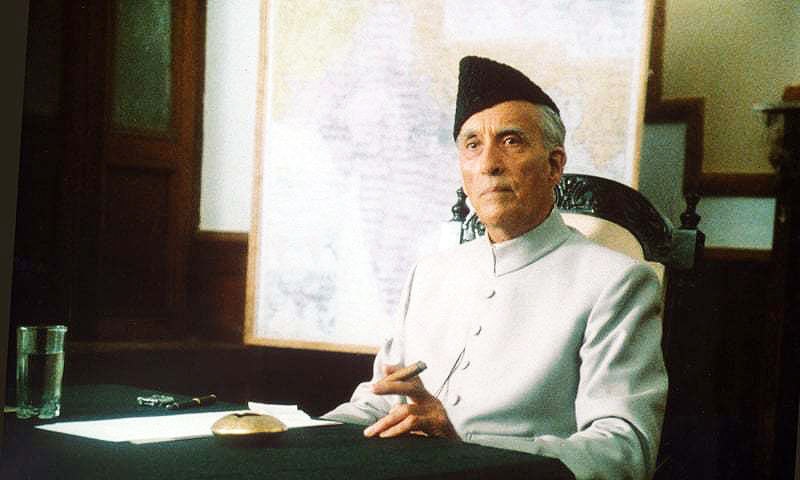
Magnificent he was, I could see his resemblance to Jinnah, though he was healthier and taller than Quaid-e-Azam.
He was wearing a dark suit and walked purposefully to the Victorian looking chair in the room. There were no oohs and aahs, but rather a respectful silence and cue for Akbar Ahmed to indicate to us the start of the Q&A session.
 |
| Cover of the March 1997 Review. |
It was then that Sir Christopher Lee looked straight at me and said, ‘Since you are the only pretty lady in the room let us begin the session with your question.’
With my heart pounding, I pressed the record button on my dicta-phone, looked down at my scratch pad, read my question and voiced it without missing a beat, my nervousness in complete check.
Me: You choose to play Mohammad Ali Jinnah, what was it about the stalwart leader that convinced you to play him?
Sir Christopher Lee: I am 75 years old now, in 1947 I was 25 and aware of Jinnah, maybe as much as I was of Mohatama Gandhi.
I was much acquainted with Jinnah the political leader, the lawyer, the person, the human.
His name was all over the newspapers and newsreels in the Britain of 50 years ago, and since I had just come out of service I was quite aware of the politics of the world.
In the war I had served with Sikhs, Muslims and Hindus, all were Indians pre-partition, and therefore nothing about playing this role seems strange.
All Pakistani and Indian actors cast in the movie are very accomplished, as are the moviemakers, and I am very excited about playing this role.
Insofar my visit here I notice, or have been told, that all buildings of consequence, public or otherwise have an in-house big photograph of Jinnah. He is an icon, a revered figure, but oddly enough a figure that most in Pakistan know nothing about except that he is the father of the nation, hence I feel it’s a very important role to play.
With that Sir Lee turned his attention to the others in the room, it gave me a chance to observe him. He was very stately, commanding and in complete control of the interview.
What struck me was that he was in Pakistan, on our turf, surrounded by over 40 seasoned journalists throwing questions at him left, right and center, but he was completely at ease, respectful of our reverence for the Quaid and ready to handle the most controversial of queries.
My friend and colleague Yadullah Ijtehadi described him well calling him ‘austerely engaging. ’ In his interview article titled, The Man They Call Jinnah published in The Review on March 20th, 1997, Yadullah wrote;
An encyclopedia described him as gaunt. His white hair was like icicles slicked back. In his 70s, tall and handsome, he looked at you in a certain way that could best be described as austerely engaging.
Tragically, the movie Jinnah did not receive the importance it deserved, and the reasons for that are many, but regardless, the performance of Lee as Jinnah was impressive and convincing.
And as for me, my face-to-face with Sir Lee became an anecdote to be told at parties. More importantly, it impressed my children when while watching Lord of the Rings with them I casually said, ‘I’ve interviewed this man.’
They looked at me and said, ‘Is there anyone you don’t know?’ But luckily for me, they did not wait for my response.