ISLAMABAD: Pakistan has assured the International Union for Conservation of Nature (IUCN) that, together with its Chinese partners, it would work to make the gigantic China-Pakistan Economic Corridor (CPEC) undertaking “environmentally and economically sustainable”.
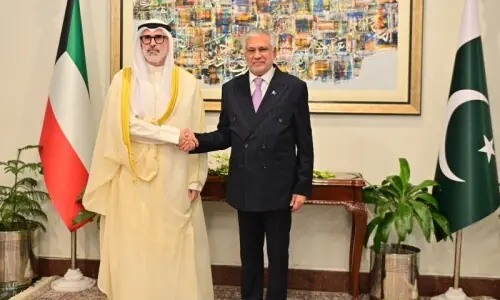
“We know that some quarters are raising voices about the potential environmental impacts of the CPEC. With the help of the Chinese government, we will address these concerns at all costs,” Federal Minister for Climate Change Senator Mushahidullah Khan told IUCN President Xinsheng Zhang who met him in the ministry on Sunday.
In March, the Pakistan Environment Protection Agency (Pak-EPA) had rejected the Environment Impact Assessment Report of the project as “incomplete and insufficient”. A private firm, hired by the National Highway Authority, had assessed the environmental damage the construction of the $46 billion CPEC may cause.
Pak-EPA maintained that the mandatory report was prepared by amateurs and lacked specific details about cutting of trees, rehabilitation of protected forest areas etc.
Environmentalists argue that cutting of trees, and impact on the shrinking mass of glaciers in northern Pakistan, in constructing vast road networks for a trade highway to connect the Gwadar port of Pakistan with western China, will have significant environmental costs.
Minister Mushahidullah assured his IUCN guest that environment and climate change scientists would be engaged to study in detail the potential hazardous impacts on the environment and livelihood of the communities the 3,000km-long economic corridor passes through.
“We will seriously look at the findings into the potential negative impacts of the CPEC and proposed measures in this regard. We will cope with potential irreparable damages to fragile ecosystems, particularly in Pakistan’s north, which is home to some 5,000 glaciers and dozens of rivers that feed the Indus River, a lifeline to the country’s agro-based economy,” he said during the meeting.
IUCN president Xinsheng promised to help in the task, adding that socio-economic development effort in the region should conform to the principles of sustainable development and environmental stability.
Natural habitat and resettlement and social sector issues are “must-meet-requirements for such large scale projects that would connect important regions of the country and trigger economic growth,” he said. Mr Xinsheng stressed mitigating environmental impacts during “all sorts of infrastructure constructions, including multi-lane road networks and bridges”.
Senator Mushahidullah urged the IUNC president to help Pakistan tackle the adverse impact of climate change, particularly on water, agriculture and energy sectors.
The minister said tax exemptions announced on import of solar panels and certain related components for one year, and on items for domestic production of solar and wind energy for five years, would help boost power generation from renewable energy sources.
Published in Dawn, June 8th, 2015
On a mobile phone? Get the Dawn Mobile App: Apple Store | Google Play