Frances W. Pritchett, a well-known critic of Urdu and professor at Columbia University, writes: “To me ghazal’s reliance on its wonderful networks of images and conventions makes it very clear that for most purposes, it is not derived from anything like actual social conditions of their [ghazal poets’] personal and collective lives. ... I argue from a wealth of evidence that the classical ghazal is indeed a game of words. But of course I would never agree that it is ‘only’ words”.
Then she draws a parallel between Urdu ghazal and country music and western music, citing the example of the “hero” of the country music, who, just like the “heroine” of Urdu ghazal, is not the “realistic depiction of particular social conditions” but an expression of emotional experiences which is “now entirely conventionalised for the modern enjoyers of the genre”.
The enjoyers of the modern Urdu ghazal cannot agree more, but there are many who believe that ghazal’s diction, imagery, traditional metaphors and ghazal’s form itself do not allow the expression of modern sensibility beyond a certain point. Hence, they favour nazm, or poem, in its various forms, such as free verse, blank verse and prose poem. Ghazal was severely criticised for certain limitations. However, despite some very influential and vociferous adversaries, such as Muhammad Hussain Azad, Altaf Hussain Hali, Josh Maleehabadi, Andleeb Shadani and Kaleemuddin Ahmed, Urdu ghazal continued to be as popular as ever and even today ghazal is one of the most popular genres of Urdu poetry. Ghazal’s popularity was contagious and even Hindi and Gujarati poets experimented successfully by composing ghazals in their language.
But modern Urdu nazm (poem), too, was not far behind. Although younger than ghazal by a few centuries, it became so popular immediately after its inception in the 1870s that in the 20th century it threatened to knock the ghazal off the high pedestal that it has been occupying for about 700 years. Today, modern Urdu poem is almost as popular as ghazal and there are many among common readers, poets and critics who prefer nazm to ghazal.
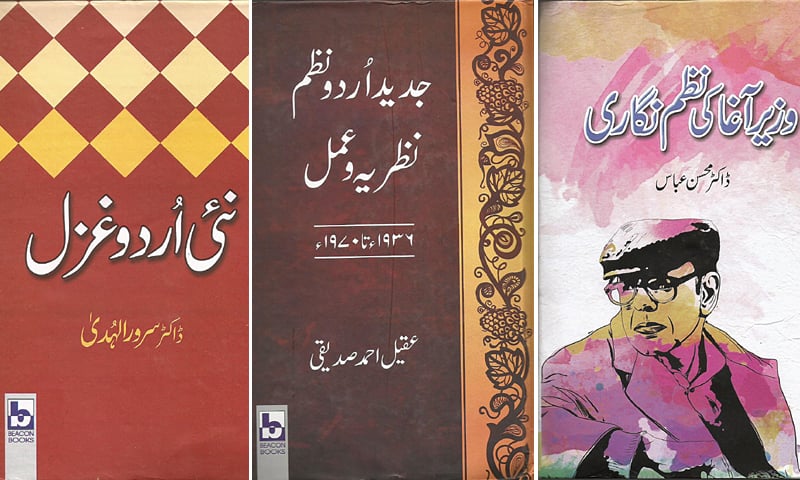
Recently, three books on Urdu ghazal and modern Urdu poem have appeared and by juxtaposing them the reader can learn about quite a few interesting aspects of these two genres that at times seem to be worlds apart. Dr Aqeel Ahmed Siddiqui, for instance, has traced the genesis and history of Urdu nazm in his book Jadeed Urdu nazm: nazariya aur amal, from 1936 to 1970. It is a fact that modern Urdu poem had to face resistance right from the beginning when Muhammad Hussain Azad and Altaf Hussain Hali floated the idea of a new kind of poem in Lahore in 1874. Then Mirajee and N. M. Rashid had to bear with the criticism of some circles that did not like the liberties these two poets were taking while commenting in their poems on certain aspects of our society’s moral and religious values. In the 1960s, something strange happened to modern Urdu poem: a group of poets and critics launched a campaign for ‘nai shaeri’ or ‘new poetry’. They not only aimed at revolutionising the diction and style of Urdu nazm, but also introduced new imagery, new symbols and different allegorical expressions to depict the inner unrest and dissatisfaction. According to Dr Siddiqui, progressive circles took exception to it and declared that the so-called new poetry and new Urdu nazm were illogical, complex and obscure. This is perhaps one of the reasons why the general perception about ‘new poetry’ or ‘modern Urdu poem’ has not been very encouraging, he adds. Dr Siddiqui is an Aligarh based researcher and Multan’s Beacon Books has published the Pakistani edition of the book.
Talking about Urdu ghazal composed in the 1960s, Dr Sarvar-ul-Huda, an Indian scholar based in Delhi, thinks that Urdu ghazals composed in both India and Pakistan in 1960s had a creative freshness and they were more depictive of their respective social and political milieu. It also portrayed the differences of the two societies but the general trend was a pronounced influence of the modernism that swept Urdu literature of the 1960s in general, says Dr Huda in his book Nai Urdu ghazal. He has also posed a thought-provoking question: have the creative fountains of our new poets of ghazal dried up? The question is apparently tilted in the favour of ghazals composed in the 1960s. This is a new, revised edition of the book published by Beacon Books.
Dr Vazeer Agha was a towering literary personality of our times. His creative genius found expression in many genres, including modern Urdu nazm. In his book Dr Vazeer Agha ki nazm nigari, Dr Mohsin Abbas has beautifully captured the essence of Vazeer Agha’s poems and in the process has also traced the historical, literary and theoretical background of Urdu nazm. He has also reviewed Vazeer Agha’s poems from the point of view of stylistics and linguistics. Published by Faisalabad’s Misaal Publishers, the book has introductions by Dr Anwer Sadeed and Dr Nasir Abbas Nayyar.
Published in Dawn, March 9th, 2015
On a mobile phone? Get the Dawn Mobile App: Apple Store | Google Play