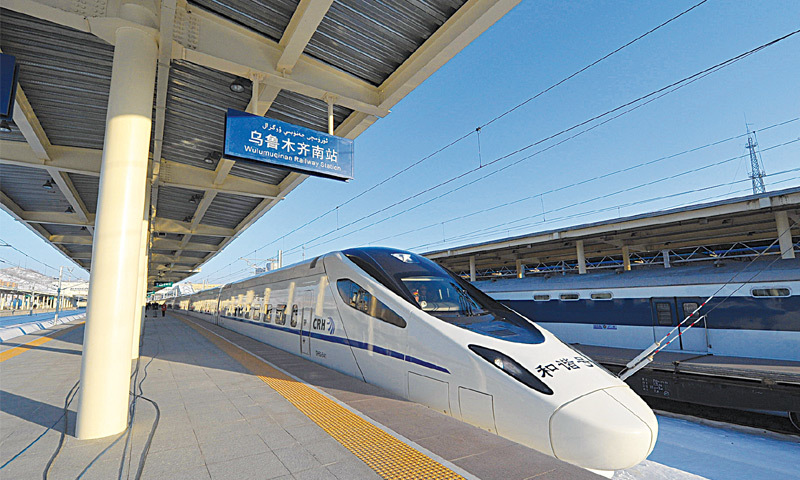

BEIJING: China tied the restive far-western region of Xinjiang closer to the rest of the country on Friday, opening a high-speed rail line between its capital Urumqi and Lanzhou, in neighbouring Gansu, nearly 1,800 kilometres away.
A slick bullet train took off from Lanzhou West Railway Station at 10:49 am (0249 GMT), with female attendants in Uighur and other ethnic costumes serving 622 passengers, live footage on state broadcaster China Central Television (CCTV) showed.
The line, the first high-speed railway in China’s remote and poor northwest, stretches through the high-altitude Qilian mountain range, an ancient section of the Great Wall and five strong wind zones, slashing travel time between the two cities by half to less than 12 hours, CCTV said.
Another train left Urumqi for Lanzhou two minutes later, according to the report.
Xinjiang, a vast area bordering Central Asia, is home to Uighurs and other mostly Muslim ethnic groups. It has long had a population of Han, China’s dominant nationality, whose numbers have increased strongly over the past half century through immigration.
Though rich in natural resources such as oil and gas, the region has been the scene of ethnic and religious unrest characterised by clashes between local groups and authorities as well as violence both inside and outside the region that Chinese authorities have classified as religious-inspired terrorism.
China is engaged in a crackdown on militancy in the region and earlier this month a court condemned eight people to death for two deadly attacks in Urumqi, state media said, bringing the number of death penalties or executions announced for Xinjiang-related violence to around 50 since June.
According to the state-run Xinhua news agency, the line linking Gansu’s capital of Lanzhou to Urumqi is 1,776 kilometres long and its trains are designed to travel at a maximum speed of 250 kilometres an hour.
Published in Dawn, December 27th, 2014